
How AI Overviews Change Organic Traffic
Understand the AI overviews impact on SEO. Learn actionable strategies to adapt your content, boost E-E-A-T, and maintain visibility in the AI era
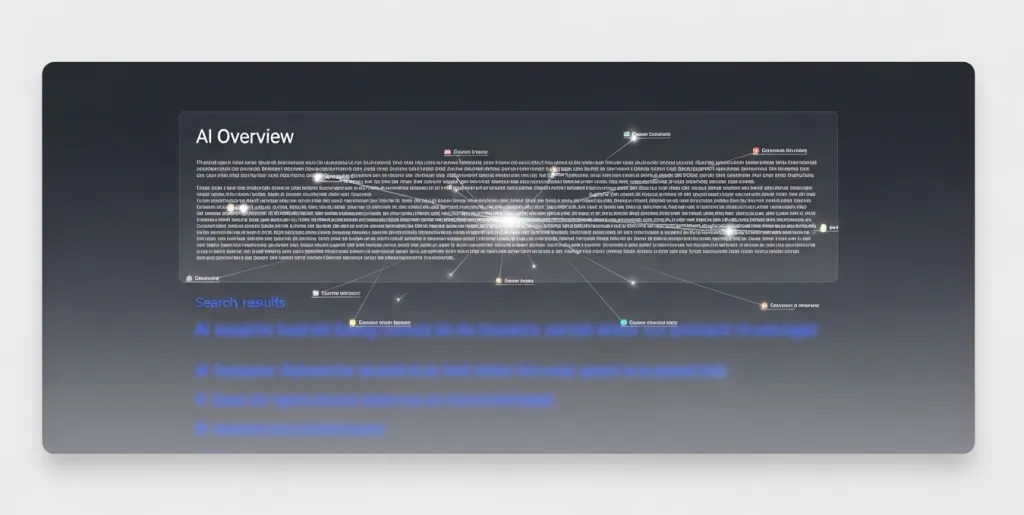
The search landscape is undergoing its most significant transformation in decades. Google's introduction of AI Overviews, formerly known as the Search Generative Experience (SGE), fundamentally alters how users interact with search results. This shift isn't just an incremental update; it represents a paradigm change, challenging established SEO practices and demanding a proactive evolution in content strategy. Understanding these changes and adapting swiftly is crucial for maintaining and growing organic visibility.
This article explores the profound implications of AI Overviews on organic traffic. We'll dissect how these AI-generated summaries impact user behavior, content discoverability, and the very definition of search success. Our focus remains on practical, actionable strategies, ensuring you're equipped to navigate this new frontier with confidence and precision.
Understanding the AI Overviews’ Impact on SEO
AI Overviews are generative AI summaries appearing at the top of Google's search results pages (SERPs) for a growing number of queries. These summaries aim to provide direct, comprehensive answers without requiring users to click through to individual websites. This direct-answer capability has a substantial impact on SEO through AI Overviews, fundamentally altering the traditional click-through model.
Initial observations reveal a significant shift in SERP layout. AI Overviews often occupy prime above-the-fold real estate, pushing traditional organic listings further down. This visual prominence means users encounter an AI-generated answer first, potentially satisfying their query immediately. For content creators and SEO professionals, this presents a dual challenge: how to get your content featured within these overviews, and how to encourage clicks when an answer is already provided.
The zero-click phenomenon, where users find their answer directly on the SERP, is amplified by AI Overviews. While featured snippets already contributed to this, AI Overviews expand the scope and depth of information provided directly. This means a user might never visit your site, even if your content contributed to the overview. Consequently, the traditional metric of organic clicks may see a decline for certain query types, necessitating a re-evaluation of what constitutes successful organic performance.
User behavior is also shifting. Users are becoming accustomed to receiving concise, synthesized information directly from Google. They expect AI summaries to be accurate, comprehensive, and relevant. This expectation places a higher burden on content creators to produce material that not only answers questions thoroughly but also does so in a structured, easily digestible format that AI can process and summarize effectively. Our team's observations indicate that content designed with clear, direct answers often fares better in AI Overview inclusion.
The Evolving Landscape of Organic Visibility
The advent of AI Overviews redefines organic visibility. Where once a top-ranking position almost guaranteed clicks, now inclusion within an AI Overview, or even a direct mention, might become the new benchmark for success. This evolution demands a nuanced understanding of how AI processes and presents information.
AI Overviews often provide direct answers, particularly for informational queries. For example, if a user asks "how to change a flat tire," the AI Overview might present step-by-step instructions directly. This scenario reduces the immediate need for a user to click through to a repair guide website. However, for more complex or commercial queries, the AI Overview might surface a summary, then prompt users to explore further, potentially linking to multiple sources. This distinction between direct answers and deeper exploration becomes critical for content strategy.
The role of authority and trust is paramount in this new landscape. Google's AI aims to provide accurate and reliable information. This means it will prioritize sources demonstrating strong E-E-A-T (Experience, Expertise, Authoritativeness, Trustworthiness). Content from established, reputable sites with clear author credentials and factual accuracy is more likely to be selected for inclusion in an AI Overview. Building and maintaining this trust signal is no longer just good practice; it's a prerequisite for visibility.
Brand mentions and entity recognition also gain new importance. AI Overviews often highlight specific brands, products, or services when relevant to a query. If a user asks for "best noise-canceling headphones," the AI might summarize key features and mention top brands directly. This provides a new avenue for brand visibility, even without a direct click to the brand's website. Optimizing for entity recognition and ensuring consistent brand mentions across authoritative sources can enhance this form of visibility.
Long-tail queries and niche content, traditionally a strong area for organic traffic, face a mixed future. On one hand, AI Overviews can efficiently summarize highly specific questions, potentially reducing clicks to niche sites. On the other hand, for truly unique or highly specialized information, AI might still rely heavily on the few authoritative sources available, potentially driving traffic to them for deeper dives. Content that offers unique insights or very specific solutions, not easily synthesized from multiple generic sources, could still thrive. The key is providing definitive, comprehensive answers that leave little room for ambiguity.
Adapting Your Content Strategy for AI Overviews
Adapting your content strategy for AI Overviews requires a fundamental shift in perspective. You're no longer just writing for human readers; you're also structuring content for AI to understand, synthesize, and present. This means prioritizing clarity, authority, and comprehensive coverage.
Prioritizing E-E-A-T in the AI Era
E-E-A-T (Experience, Expertise, Authoritativeness, Trustworthiness) has always been a core tenet of Google's quality guidelines, but its importance is magnified with AI Overviews. AI needs to trust the sources it summarizes.
- Experience: Demonstrate practical application and first-hand knowledge. If you're discussing a product, share your personal usage experience. For a tutorial, walk through the steps as if you've done it yourself. This isn't just about stating facts; it's about showing you've lived them.
- Expertise: Showcase deep knowledge and specialization in your niche. Your content should reflect a profound understanding of the subject matter, going beyond surface-level explanations. This often involves detailed explanations, nuanced discussions, and a clear grasp of complex concepts.
- Authoritativeness: Build recognition from peers, industry leaders, and other authoritative sources. This can manifest through backlinks from reputable sites, mentions in industry publications, or a strong professional reputation. Google's algorithms use these signals to gauge your site's standing.
- Trustworthiness: Ensure accuracy, transparency, and a solid reputation. Provide verifiable facts, cite sources where appropriate, and maintain an up-to-date, secure website. Disclose any potential biases or affiliations. A transparent approach builds user and AI trust.
For example, a financial advice blog that clearly lists the credentials of its authors (e.g., "Certified Financial Planner") and cites reputable financial institutions for data points will inherently possess stronger E-E-A-T than an anonymous blog offering generic advice. This level of detail signals to AI that the content is reliable.
Crafting AI-Optimized Content
Creating content that AI can effectively process and summarize is paramount. This involves a strategic approach to structure, language, and depth.
- Clarity and Conciseness: AI thrives on direct answers. Structure your content to provide clear, concise responses to potential questions, particularly in introductory paragraphs or dedicated answer sections. Avoid jargon where simpler terms suffice, but use precise industry terminology when necessary for accuracy.
- Structured Data and Semantic Markup: Leverage schema markup (e.g., FAQ schema, HowTo schema, Article schema) to explicitly tell search engines what your content is about and what specific answers it provides. This semantic layer helps AI understand the context and extract relevant information more efficiently.
- Comprehensive Coverage with Depth: While conciseness is key for AI extraction, the underlying content must still be comprehensive. Aim to be the definitive source on a topic, covering all angles, common questions, and related subtopics. This depth signals authority and ensures AI has ample material to draw from.
- Addressing User Intent Explicitly: Anticipate the various intents behind a query and address them directly. If a user searches for "best running shoes," they might want reviews, buying guides, or comparisons. Structure your content to cater to these different intents, making it easier for AI to match the right information to the user's specific need.
- Using Headings and Subheadings Effectively: Employ a logical H2/H3 hierarchy to break down complex topics into digestible sections. Each heading should clearly indicate the content that follows, acting as signposts for both human readers and AI. This structure allows AI to quickly identify and summarize specific segments of your article.
The Power of Unique Perspectives and Original Research
AI Overviews, by their nature, synthesize existing information. To stand out and truly capture AI's attention, your content needs to offer something new. Unique perspectives, original research, and proprietary data are invaluable assets.
Why does AI value novel insights? Because it can't generate them itself without a foundational source. If your content presents a unique study, a novel solution, or a distinct viewpoint not widely available elsewhere, it becomes a primary source that AI must reference. This positions your site as an authority and an essential contributor to the collective knowledge base.
Case Study 1: Optimizing a "How-To" Guide for AI Overviews
Our team observed a client's "how-to" guide on a common software task. Initially, it was a long-form article with excellent detail but lacked clear, concise summary points. When AI Overviews rolled out, this guide rarely appeared in the summaries, despite its high organic ranking.
We implemented several adjustments:
- Added a "Quick Summary" box at the top, outlining the main steps in bullet points.
- Restructured headings to be more question-based (e.g., "What You'll Need," "Step 1: Prepare Your Workspace").
- Integrated HowTo schema markup, explicitly detailing each step.
- Included a "Common Pitfalls" section based on our team's direct experience, providing unique troubleshooting insights.
Within weeks, the guide began appearing in AI Overviews for specific steps, and we saw an increase in branded searches, even if direct clicks didn't surge. This indicated that while users might get the immediate answer from the overview, our brand was being recognized as the authoritative source, leading to later direct navigation. This demonstrated that even without a direct click, brand visibility and authority could improve.
Technical SEO Adjustments for AI Overviews
While content strategy is paramount, foundational technical SEO remains critical. A technically sound website ensures that AI can easily crawl, understand, and index your content, making it eligible for inclusion in overviews.
Schema Markup Optimization: This is more important than ever. Beyond basic organization schema, focus on specific types that directly relate to your content's purpose. For instance:
HowToschema for step-by-step guides.FAQPageschema for question-and-answer sections.Articleschema for blog posts and news.Productschema for e-commerce pages.Reviewschema for product or service reviews. Properly implemented schema helps AI parse the specific data points it needs to construct an overview, acting as a direct signal to Google about your content's structure and intent.
Site Speed and Core Web Vitals: These performance metrics are not just for human users; they also influence how efficiently Google's crawlers and AI systems can access and process your content. A slow site hinders crawlability and can signal a poor user experience, potentially reducing your chances of being featured. Optimizing Largest Contentful Paint (LCP), Cumulative Layout Shift (CLS), and Interaction to Next Paint (INP) ensures a smooth experience for all, including AI.
Mobile-First Indexing and Responsiveness: Google operates on a mobile-first indexing principle. This means the mobile version of your site is the primary one used for indexing and ranking. AI Overviews will also prioritize content that performs well on mobile devices. Ensure your site is fully responsive, loads quickly on mobile, and provides an excellent user experience across all screen sizes. This is an essential, non-negotiable aspect of modern SEO.
Internal Linking Strategies: A robust internal linking structure helps AI understand the hierarchy and relationships between different pieces of content on your site. It also distributes "link equity" and signals topical authority. When you link relevant articles together, you tell AI that your site possesses deep expertise on a particular subject, making it a more credible source for comprehensive overviews. Use descriptive anchor text that accurately reflects the linked content.
Measuring Success in the AI-Dominated SERP
The traditional metrics of organic traffic and keyword rankings, while still relevant, no longer tell the whole story. The rise of AI Overviews necessitates a re-evaluation of how we measure SEO success.
Rethinking Traditional Metrics: A direct decline in organic clicks for certain queries doesn't automatically equate to failure. If your content is consistently featured in AI Overviews, it still achieves significant visibility and brand exposure. We must expand our definition of "success" to include metrics beyond just clicks. This might involve tracking impressions, brand mentions, and the perceived authority of your site.
Tracking AI Overview Inclusion: Currently, there isn't a direct reporting feature in Google Search Console for AI Overview inclusion. However, you can monitor this manually by performing searches for your target keywords and observing if your content is cited. Tools that scrape SERP data can also help identify instances where your site contributes to an AI Overview. This proactive monitoring helps you understand which content types and strategies are most effective.
Monitoring Brand Mentions and Impressions: Even if a user doesn't click through, seeing your brand mentioned in an AI Overview can build brand awareness and recall. Track brand mentions across the web and monitor impression data in Search Console closely. An increase in impressions, even with stable or slightly reduced clicks, might indicate increased visibility through AI Overviews. This can lead to direct navigation later, as seen in Case Study 1.
Analyzing User Behavior Post-AI Overview: Investigate how users interact with your site after an AI Overview appears. Are they still clicking through for deeper dives, additional context, or specific calls to action? Analyze bounce rates, time on page, and conversion rates for traffic originating from queries likely to trigger AI Overviews. This helps determine if your content successfully entices users to engage further, even after receiving a summary. If users are still engaging deeply, it suggests your content offers unique value beyond the AI's summary.
Future-Proofing Your SEO Strategy
The pace of change in search is accelerating. Future-proofing your SEO strategy means embracing adaptability, diversification, and a holistic approach that prioritizes long-term value over short-term hacks.
Embracing a Holistic Approach: SEO can no longer be viewed in isolation. It must integrate seamlessly with your overall content marketing, brand building, and user experience efforts. Focus on creating genuinely valuable content that serves your audience, regardless of how Google's algorithms evolve. This means moving beyond keyword stuffing and towards comprehensive, authoritative resources.
Diversifying Traffic Sources: Relying solely on organic search traffic, especially in a world of AI Overviews, carries increased risk. Explore and invest in other traffic channels:
- Email marketing: Build a strong subscriber base.
- Social media: Engage with your audience and drive traffic.
- Paid advertising: Supplement organic efforts for critical campaigns.
- Direct traffic: Cultivate brand loyalty that encourages direct visits.
- Referral traffic: Collaborate with other sites and thought leaders. A diversified approach ensures resilience against algorithm changes and shifts in search behavior.
Staying Agile and Iterative: The SEO landscape is dynamic. What works today might be less effective tomorrow. Adopt an agile methodology:
- Monitor changes: Keep an eye on Google announcements and industry trends.
- Test hypotheses: Experiment with different content formats and optimization techniques.
- Analyze results: Use data to inform your next steps.
- Iterate quickly: Be prepared to adjust your strategy based on new insights. This continuous cycle of learning and adaptation is crucial for long-term success.
Continuous Learning and Experimentation: The only constant is change. Invest in continuous learning for yourself and your team. Attend webinars, read industry reports, and participate in communities. Experiment with new technologies and content formats. For instance, consider how video content or interactive tools might be summarized or referenced by AI in the future. Proactive experimentation allows you to discover new opportunities before they become mainstream.
Case Study 2: A Niche E-commerce Site's AI Adaptation
A small e-commerce client specializing in artisanal coffee beans faced a challenge. Their product pages, while detailed, weren't being featured in AI Overviews for general coffee-related queries. Their blog content, which focused on coffee brewing techniques and bean origins, also saw declining clicks as AI summarized basic "how-to" questions.
Our team advised a strategic pivot:
- Enhanced Product Descriptions: We added unique, in-depth stories about each bean's origin, processing, and flavor profile, going beyond generic descriptions. This provided unique, non-summarizable content.
- Developed "Expert Guides": Instead of basic "how-to" articles, they created comprehensive "Expert Guides" on topics like "The Science of Espresso Extraction" or "Understanding Coffee Acidity." These guides featured original research, detailed diagrams, and interviews with coffee farmers, establishing the site as a deep authority.
- Integrated Customer Reviews: They heavily promoted customer reviews, including detailed feedback on flavor notes and brewing experiences. This user-generated content provided social proof and unique data points.
- Focused on Community Building: They launched a forum and an email newsletter, fostering a loyal community that engaged directly with their content and products, reducing reliance on organic search for repeat customers.
The results were significant. While direct organic clicks for basic queries remained stable or slightly declined, their "Expert Guides" started appearing as primary sources in AI Overviews for more complex coffee topics. More importantly, direct traffic and email list growth surged, indicating a stronger brand connection. This demonstrated that by providing truly unique, authoritative content and diversifying engagement, they could thrive despite the AI Overview impact on SEO.
The Ethical Imperative: Responsible AI Content Creation
As AI plays a larger role in content distribution, the ethical considerations for content creators become more pronounced. Responsible content creation is not just about compliance; it's about maintaining trust and integrity in the digital ecosystem.
Accuracy and Factual Integrity: With AI synthesizing information, any inaccuracies in your source content can be propagated widely. Double-check all facts, data, and claims. Avoid hyperbole or misleading statements. Your content must be a beacon of truth, especially when AI is relying on it to inform users.
Transparency and Attribution: If you use AI tools in your content creation process, consider transparency. While Google doesn't penalize AI-generated content, the quality and originality are key. More importantly, when AI Overviews cite your content, ensure the information is clearly attributable to your site. This reinforces your authority and gives users a clear path to the original source.
Avoiding AI-Generated Fluff: The temptation to quickly generate vast amounts of content using AI is real. However, content that lacks genuine insight, originality, or human value will likely struggle to gain traction with AI Overviews. Google's AI aims to provide helpful, reliable information. Content that merely rehashes existing ideas without adding value will likely be overlooked in favor of more authoritative, human-curated sources. Prioritize quality over quantity, always.
Conclusion: Adapting to a Generative Search Future
The introduction of AI Overviews marks a pivotal moment in the evolution of organic search. It challenges us to move beyond traditional SEO tactics and embrace a more sophisticated, user-centric, and AI-aware approach. The AI Overviews impact on SEO is undeniable, shifting the focus from mere keyword rankings to comprehensive authority, unique value, and transparent expertise.
To thrive in this generative search future, you must prioritize E-E-A-T, craft content that is both comprehensive and AI-digestible, and continuously adapt your technical SEO. Rethink your metrics of success, embracing brand visibility and direct engagement alongside traditional clicks. Diversify your traffic sources and maintain an agile, experimental mindset. Ultimately, the future of organic traffic belongs to those who create genuinely helpful, authoritative, and trustworthy content that serves both human users and advanced AI systems. The journey ahead demands strategic thinking and a commitment to quality, ensuring your content remains discoverable and valuable in an ever-evolving digital landscape.
Frequently Asked Questions (FAQ)
Q1: Will AI Overviews completely eliminate the need for organic clicks?
Not entirely. While AI Overviews provide direct answers for many queries, users will still click through for deeper dives, more nuanced information, specific product details, or calls to action.
Q2: How can I ensure my content is chosen for an AI Overview?
Focus on strong E-E-A-T, provide clear and concise answers to common questions, use structured data (schema markup), and create comprehensive, authoritative content on your topic.
Q3: Should I stop creating long-form content because of AI Overviews?
No, long-form content is still valuable. AI Overviews often synthesize information from comprehensive sources. By being the definitive authority on a topic, your content provides the depth AI needs, even if it only extracts a summary.
Q4: Is it okay to use AI to help write my content?
Yes, using AI as a tool is acceptable, but ensure the final content is accurate, original, and provides genuine value. Google prioritizes helpful, reliable content, regardless of how it's generated.
Q5: How do I measure the success of my content in AI Overviews?
Monitor brand mentions, impressions, and direct traffic. While direct click-through rates might change, increased brand visibility and authority, even without a click, indicate success in the AI-dominated SERP.