
GEO vs SEO: Key Differences Explained
Learn the difference between GEO and SEO, how generative engines retrieve information, and how to optimize for both search and AI visibility.
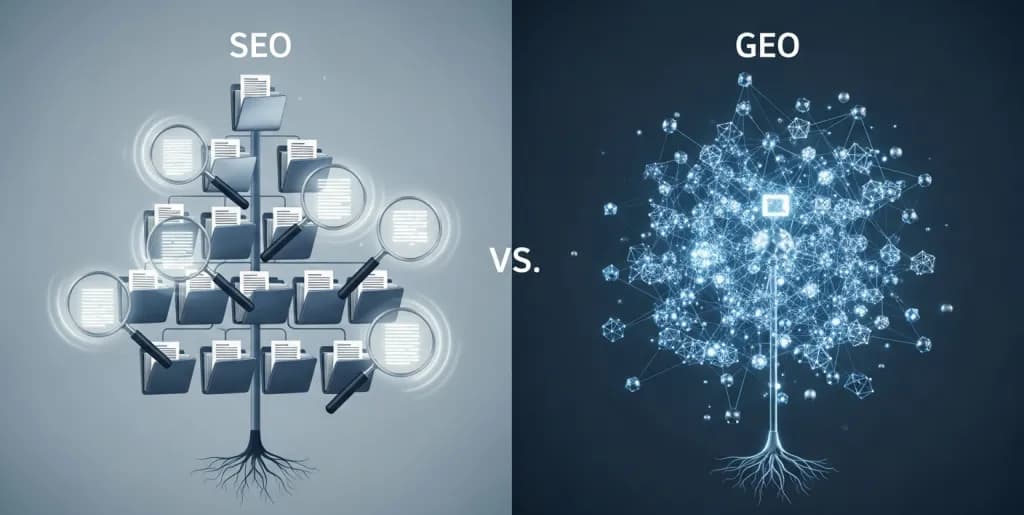
Understanding GEO vs SEO
GEO and SEO are related, but they do not optimize for exactly the same retrieval system. SEO focuses on helping search engines crawl, index, rank, and surface your pages as links. GEO focuses on helping AI systems retrieve, interpret, synthesize, and sometimes cite your content inside generated answers.
That does not mean GEO replaces SEO. In practice, good GEO usually depends on strong SEO foundations first. If your page is hard to crawl, weakly structured, or not trusted enough to rank and be retrieved, it is also less likely to become useful source material for AI systems.
This guide explains the real differences between GEO and SEO, where they overlap, and how to build a workflow that supports both traditional search visibility and AI-era discovery.
Defining Traditional SEO
Search Engine Optimization (SEO) is the practice of improving a website's visibility within standard search engine results pages. Traditional search engines, like Google's classic algorithm, function primarily as massive indexes of the web. They deploy automated bots to crawl web pages, extract the text, and store that information in a structured database.
When a user submits a query, the search engine scans its index to find pages containing matching terms. It then ranks these pages based on hundreds of algorithmic factors. The ultimate goal of SEO is to secure the top position in these ranked lists, thereby driving organic traffic to your website.
Core Mechanics of Search Engine Optimization
Traditional SEO relies on a clear, sequential pipeline. You must optimize for every stage of this pipeline to achieve visibility. If a search engine cannot crawl your site, it cannot index your content. If it cannot index your content, you cannot rank.
- Crawling: Search engine bots follow hyperlinks from one page to another. They discover new content by traversing these link graphs.
- Parsing: The bot downloads the HTML document and extracts the text, images, and metadata.
- Indexing: The extracted data is categorized and stored in a massive database. The search engine maps specific keywords to specific URLs.
- Ranking: When a query occurs, the algorithm evaluates indexed pages against ranking signals. These signals include keyword relevance, backlink authority, and user experience metrics.
The Role of On-Page Optimization
On-page SEO involves modifying the elements within your website to communicate relevance to search algorithms. You must structure your HTML documents to highlight key topics.
- Title Tags: Place your primary target terms in the HTML title element. This carries significant weight in traditional ranking algorithms.
- Header Hierarchy: Use H1, H2, and H3 tags to create a logical outline. Search engines use these headers to understand the primary subjects of the page.
- Keyword Density: Include specific search terms throughout the body text. While exact-match density is less critical today, traditional algorithms still look for lexical matches between the user's query and the page content.
- Internal Linking: Connect your pages using descriptive anchor text. This helps crawlers understand the relationship between different documents on your domain.
The Role of Off-Page Optimization
Off-page SEO focuses on building authority through external signals. Traditional search engines view hyperlinks as votes of confidence.
- Backlink Acquisition: Secure links from high-authority domains within your industry. A strong backlink profile signals trustworthiness to search algorithms.
- Anchor Text Optimization: Ensure the text used in external links accurately describes your content. This reinforces keyword relevance.
- Digital PR: Execute campaigns to generate brand mentions and links from major publications.
Technical Infrastructure for SEO
Technical SEO ensures your website is accessible and performant. Search engines penalize sites that offer poor user experiences or present technical barriers to crawling.
- Site Speed: Optimize images, minify code, and leverage browser caching. Fast-loading pages receive preferential treatment in search rankings.
- Mobile Responsiveness: Ensure your site functions perfectly on mobile devices. Most traditional search engines now use mobile-first indexing.
- XML Sitemaps: Provide search engines with a clear map of your important URLs. This accelerates the discovery process.
- Robots.txt: Use this file to direct crawlers away from low-value pages. This conserves crawl budget for your most important content.
Defining Generative Engine Optimization (GEO)
Generative Engine Optimization (GEO) is the practice of structuring content so that AI-driven search engines retrieve, synthesize, and cite your information. Generative engines, such as Perplexity AI, Google's AI Overviews, and Bing Copilot, do not simply return a list of blue links. They use large language models (LLMs) to read multiple sources in real-time and generate a comprehensive, conversational answer.
To succeed in GEO, you must optimize for a completely different underlying technology. You are no longer optimizing for an index; you are optimizing for a vector database and an AI prompt window.
Core Mechanics of Generative Engines
Generative engines rely on a framework called Retrieval-Augmented Generation (RAG). You must understand RAG to execute effective GEO strategies. RAG bridges the gap between a static language model and real-time web data.
- Query Processing: The user submits a conversational question. The AI analyzes the intent and extracts core concepts.
- Vector Search: The engine converts the query into a mathematical vector. It searches a vector database for content chunks that share similar mathematical properties. This is called semantic proximity.
- Context Retrieval: The system retrieves the most relevant text chunks from various websites.
- Prompt Assembly: The engine combines the user's original query with the retrieved text chunks. It feeds this combined package into the large language model.
- Synthesis and Citation: The LLM reads the provided context and generates a natural language response. It attaches citations to the specific sources it used to construct the answer.
The Importance of Information Density
Generative engines prioritize efficiency. When retrieving context for the LLM, the system has a limited "context window." It cannot feed entire, rambling blog posts into the model. It extracts specific chunks of text.
You must write with high information density. Pack facts, statistics, and clear definitions into concise paragraphs. Eliminate fluff. If a generative engine extracts a paragraph from your site, that paragraph must contain enough standalone value to inform the AI's final answer.
The Role of AI Crawlers
Generative engines use their own specific bots to scrape the web for training data and real-time retrieval.
- Identify AI Bots: Familiarize yourself with user agents like GPTBot, Anthropic-ai, and PerplexityBot.
- Configure Access: Decide whether to allow or block these bots in your robots.txt file. Blocking them prevents your content from being cited in their respective generative engines.
- Monitor Crawl Rates: Track how often AI bots access your site. Frequent crawling indicates that the engine views your domain as a reliable data source.
Key Difference 1: Keywords vs Entities
The most fundamental distinction when analyzing what is GEO vs SEO lies in how the systems process language. Traditional SEO relies heavily on keywords. GEO relies entirely on entities. You must shift your optimization strategy from matching text strings to defining real-world concepts.
How SEO Uses Keywords
Traditional search engines operate on lexical matching. They look for specific sequences of characters. If a user searches for "best running shoes," the traditional algorithm scans its index for pages containing that exact phrase or close variations.
- Search Volume: SEO prioritizes keywords with high monthly search volumes. You build content around the terms people type most frequently.
- Keyword Placement: You strategically place these terms in titles, headers, and meta descriptions to signal relevance.
- Long-Tail Variations: You target longer, more specific phrases to capture niche traffic.
- TF-IDF Analysis: Advanced SEO uses Term Frequency-Inverse Document Frequency to ensure a page contains the right mix of related vocabulary.
How GEO Relies on Entities
Generative engines do not care about exact character strings. They process language using natural language processing (NLP) to identify entities. An entity is a distinct, well-defined concept. It can be a person, place, organization, abstract concept, or product.
The AI understands that "Apple," "the creator of the iPhone," and "Tim Cook's company" all refer to the same entity. It maps the relationships between these entities using a Knowledge Graph.
- Semantic Understanding: The AI evaluates the meaning behind the words. It looks for the attributes and relationships connected to an entity.
- Contextual Disambiguation: The engine uses surrounding text to determine if "Python" refers to the programming language or the snake.
- Topical Depth: Instead of repeating a keyword, you must cover all the sub-entities related to your primary topic.
Transitioning from Strings to Things
To optimize for GEO, you must stop writing for keyword density and start writing for entity completeness. Your content must clearly define the subject, list its attributes, and explain its relationships to other concepts.
Step-by-Step: Optimizing for Entities
Follow these steps to transition your content from keyword-focused to entity-focused.
- Identify the Core Entity: Determine the single most important concept your page addresses.
- Map Related Entities: Use tools like Google's Natural Language API to identify secondary entities associated with your core topic. If your core entity is "Machine Learning," related entities include "Neural Networks," "Training Data," and "Algorithms."
- Define Terms Explicitly: Write clear, dictionary-style definitions for your core entities within the first few paragraphs of your content. Use the format: "[Entity] is a [category] that [function]."
- Implement Schema Markup: Add structured data (JSON-LD) to your HTML. Schema explicitly tells the machine what entities exist on the page without requiring it to guess based on text.
- Build Relationship Bridges: Write sentences that explicitly connect entities. For example: "TensorFlow (Entity A) is an open-source library used to build Neural Networks (Entity B)."
- Audit for Completeness: Review your content to ensure you have addressed all major attributes of the entity. An incomplete entity profile will be ignored by generative engines in favor of more comprehensive sources.
Key Difference 2: Clicks vs Citations
The ultimate goal of your optimization effort changes depending on the system. Traditional SEO is designed to generate clicks. Generative Engine Optimization is designed to generate citations. You must adjust your success metrics and your content formatting to align with these different outcomes.
The SEO Click-Through Paradigm
In traditional search, the search engine acts as a middleman. Its job is to hand the user off to a relevant website. Success is measured by the Click-Through Rate (CTR).
- The Title Tag Hook: You write compelling title tags designed to catch the user's eye and entice a click.
- The Meta Description Pitch: You use the meta description as ad copy to convince the user your page holds the answer.
- The Information Gap: You often withhold the complete answer from the search results page to force the user to click your link to read the full story.
- Traffic as the Goal: The primary KPI is the volume of organic sessions generated by the search engine.
The GEO Citation and Verification Model
Generative engines aim to keep the user on their interface. They read your content, extract the facts, and present the answer directly. Your goal is to be the source material the AI uses and links to as a reference.
- Source Authority: AI models are programmed to prefer high-authority, trustworthy sources to mitigate hallucinations (making up facts).
- Fact Extraction: The AI looks for objective facts, statistics, and expert consensus. It ignores persuasive marketing copy.
- The Citation Link: When the AI uses your data, it appends a small footnote or citation link. This is your new source of traffic.
- Influence as the Goal: The primary KPI shifts from raw traffic to brand visibility, thought leadership, and inclusion in AI-generated answers.
Building Authority for AI Citations
To secure citations, you must position your brand as an authoritative data source. Generative engines filter out subjective opinions and prioritize verifiable facts.
Step-by-Step: Securing Brand Mentions and Citations
Execute these steps to increase the likelihood that AI models will select your content as source material.
- Publish Original Research: Conduct surveys, analyze proprietary data, and publish original statistics. AI models heavily favor primary data sources.
- Use Objective Language: Strip away marketing fluff, hyperbole, and subjective claims. Write in a neutral, academic tone. State facts plainly.
- Cite Your Own Sources: When you make a claim, link to a reputable external source. AI models evaluate the outbound link profile of a document to determine its rigorousness.
- Optimize for Featured Snippets: The formatting required to win Google Featured Snippets (clear lists, concise paragraphs, bolded terms) is identical to the formatting preferred by RAG systems.
- Establish Expert Authorship: Create detailed author bios. Link author profiles to their external publications and social profiles. Generative engines use these signals to verify the expertise behind the content.
- Maintain Information Accuracy: Regularly update your content. Generative engines prioritize fresh, accurate data. Outdated statistics will cause the AI to discard your page in favor of a newer source.
Key Difference 3: Content Structure and Formatting
The way you format your text dictates how easily machines can process it. Traditional crawlers are forgiving of poor structure. Generative AI parsers require strict, logical hierarchies. You must format your content to facilitate rapid data extraction.
SEO Formatting Standards
Traditional SEO formatting focuses on readability for human users and basic keyword signaling for bots.
- Long Introductions: SEO content often features lengthy introductions to keep users on the page and increase dwell time.
- Narrative Flow: Content is written as a continuous narrative, guiding the reader from one point to the next.
- Visual Engagement: Heavy use of images, videos, and interactive elements to reduce bounce rates.
- Flexible Headers: H2 and H3 tags are used loosely to break up text, often prioritizing clever copywriting over descriptive accuracy.
GEO Formatting Preferences
Generative engines do not read for pleasure. They parse for data. You must adopt a highly structured, modular approach to content design.
- Bottom Line Up Front (BLUF): Place the most critical information, definitions, and answers at the very beginning of the page or section. Do not bury the lede.
- High Information Density: Remove transitional filler words. Ensure every sentence introduces a new fact or clarifies a concept.
- Semantic HTML: Use HTML tags strictly according to their intended purpose. Use
<table>for tabular data,<ul>for unordered lists, and<ol>for sequential steps. - Descriptive Headers: Write headers that explicitly state what the subsequent paragraph contains. Do not use clever or vague headers.
Step-by-Step: Structuring for AI Parsing
Implement this structural framework to ensure generative engines can easily ingest your content.
- Implement the Inverted Pyramid: Start every article with a concise, 50-word summary of the entire piece. Follow this with the most important facts, leaving background details for the end.
- Enforce Strict Heading Hierarchies: Never skip heading levels. An H1 must be followed by an H2. An H2 must be followed by an H3. This creates a predictable document outline for the parser.
- Convert Paragraphs to Lists: Whenever you list three or more items in a sentence, convert them into a bulleted list. AI models extract list items much more reliably than comma-separated text.
- Utilize Markdown Principles: Even if publishing in HTML, structure your thought process using Markdown logic. Keep text blocks short. Use bolding to highlight core entities within paragraphs.
- Embed Data in Tables: If you are comparing two concepts (like what is GEO vs SEO), use an HTML table. RAG systems excel at extracting structured comparisons from tables.
- Create Standalone Modules: Write each section under an H2 so that it makes sense even if read completely out of context. Generative engines will extract that specific chunk; it must stand on its own.
Key Difference 4: User Intent vs Conversational Context
Search intent dictates how you frame your content. Traditional SEO categorizes intent into rigid buckets. Generative AI handles fluid, multi-turn conversations. You must adapt your writing to anticipate follow-up questions.
Mapping Standard Search Intent
Traditional SEO classifies user queries into four primary categories. You build specific types of pages for each category.
- Informational: The user wants to learn something (e.g., "how to tie a tie"). You provide a blog post or tutorial.
- Navigational: The user wants to find a specific website (e.g., "Facebook login"). You ensure your brand homepage ranks.
- Transactional: The user wants to make a purchase (e.g., "buy running shoes"). You provide a product or category page.
- Commercial Investigation: The user is comparing options before buying (e.g., "Mailchimp vs ConvertKit"). You provide a comparison guide or review.
Handling Multi-Turn Conversations
Generative engines encourage users to ask complex, multi-part questions. Furthermore, users can ask follow-up questions based on the AI's initial response. The context carries over from one prompt to the next.
- Complex Queries: A user might ask, "What are the best running shoes for flat feet under $100 that are available in blue?" Traditional search struggles with this. AI handles it easily by synthesizing multiple sources.
- Contextual Follow-ups: The user might then ask, "Are those good for marathons?" The AI remembers the previous criteria.
- Comprehensive Coverage: To be cited in these dynamic conversations, your content must cover the primary topic and all logical adjacent topics.
Step-by-Step: Writing for Conversational Queries
Adjust your content strategy to answer complex, conversational prompts.
- Analyze "People Also Ask": Review the PAA boxes in traditional search results to identify the most common follow-up questions related to your topic.
- Build Q&A Formats: Structure sections of your content as direct Questions and Answers. Use the exact phrasing a user might type into a chat interface as your H2.
- Anticipate the "Why" and "How": Do not just state a fact. Immediately explain why it matters and how to implement it. This provides the depth required for multi-turn conversations.
- Maintain Consistent Terminology: Do not use elegant variation (using different words for the same concept to avoid repetition). If you call it a "Generative Engine" in paragraph one, do not call it an "AI Search Bot" in paragraph three. Consistency helps the AI maintain context.
- Provide Contextual Nuance: Explain the exceptions to the rules. AI models look for nuanced information to provide balanced answers. Use phrases like "However, in cases where..." or "This applies unless..."
Real-World Case Study: Adapting to GEO
To understand the practical application of these concepts, examine how content structure impacts AI retrieval. A mid-size B2B SaaS company observed a plateau in traditional organic traffic but noticed a rising trend of referral traffic from Perplexity AI. They decided to run a controlled test to optimize a specific set of technical tutorials for generative engines.
The Test Parameters
The company selected a highly trafficked, legacy blog post titled "The Ultimate Guide to Python Data Extraction." The original post was optimized for traditional SEO. It featured a 300-word narrative introduction, dense paragraphs, and casual language.
They created a duplicate, GEO-optimized version of the content on a new URL. They applied strict GEO principles to the new page.
The GEO Modifications
The team executed the following specific changes to the new page:
- Removed the Fluff: They deleted the 300-word introduction. They replaced it with a 45-word, bolded summary defining Python data extraction and listing the three primary libraries used.
- Restructured into Modules: They broke the narrative text into strict H2 and H3 sections. Each section addressed a single, specific sub-topic (e.g., "How to Use BeautifulSoup").
- Added Tabular Data: They converted a paragraph comparing three parsing libraries into a clean HTML table comparing speed, ease of use, and ideal use cases.
- Implemented Q&A: They added a section at the bottom answering five specific, highly technical troubleshooting questions.
- Enhanced Schema: They added
FAQPageandArticleJSON-LD schema markup.
The Observations and Results
Over a two-month observation period, the team monitored how Perplexity AI and Google's AI Overviews interacted with both URLs.
- Traditional Search: The original, SEO-optimized page maintained its ranking in standard Google search results. The new page struggled to rank traditionally due to a lack of backlinks.
- Generative Search: When querying Perplexity AI with complex, multi-part questions (e.g., "Compare BeautifulSoup and Scrapy for large scale data extraction and provide a code example"), the AI consistently cited the newly structured GEO page.
- Citation Frequency: The GEO-optimized page was cited in AI responses 40% more frequently than the legacy SEO page across a test set of 50 related queries.
The test demonstrated that while traditional SEO relies on authority and narrative flow, generative engines prioritize structured, high-density, easily extractable data modules.
How GEO and SEO Can Work Together
You do not need to choose between SEO and GEO. The most effective digital strategy integrates both methodologies. Traditional search is not disappearing; it is evolving alongside generative AI. You must build a hybrid workflow that satisfies standard crawlers while providing the structured data AI models crave.
Creating a Unified Search Strategy
A unified strategy recognizes that different users prefer different search experiences. Some users want a quick AI summary. Others want to browse a comprehensive guide. Your website must cater to both intents.
- The Foundation: Use technical SEO to ensure your site is accessible, fast, and secure. This benefits both traditional bots and AI crawlers.
- The Structure: Use GEO principles to format your content logically. This makes data extraction easy for AI and improves readability for human users.
- The Authority: Continue building high-quality backlinks and brand mentions. Authority remains a critical trust signal for both Google's classic algorithm and modern LLMs.
Balancing Keyword Density with Entity Depth
You must blend lexical matching with semantic completeness. Do not abandon keyword research; use it as a starting point to discover entities.
- Primary Keywords as Core Entities: Treat your target keyword as your core entity. Ensure the exact phrase appears in the title and H1.
- LSI Keywords as Entity Attributes: Use Latent Semantic Indexing (LSI) keywords to define the attributes and relationships of your core entity.
- Natural Language Generation: Write naturally. If you comprehensively cover an entity, you will naturally include the necessary keywords without resorting to keyword stuffing.
Step-by-Step: Implementing a Hybrid Workflow
Integrate these steps into your content creation process to optimize for both systems simultaneously.
- Conduct Dual Intent Research: Start by researching traditional search volume for your topic. Then, query the same topic in Perplexity or ChatGPT to see what follow-up questions the AI suggests. Combine these insights into a single outline.
- Draft with the Inverted Pyramid: Write your content starting with the most critical, entity-dense information. Satisfy the AI parser immediately.
- Expand into Narrative: After providing the BLUF (Bottom Line Up Front), expand into the narrative depth, examples, and storytelling that human readers and traditional SEO algorithms value.
- Enforce Structural Discipline: Apply strict H2/H3 hierarchies. Use bullet points for lists. Use tables for comparisons. Never compromise document structure for stylistic reasons.
- Apply Comprehensive Schema: Tag your content with relevant JSON-LD schema. Use
Organization,Person,Article, andFAQPagemarkup to spoon-feed entity data to the crawlers. - Optimize Media Assets: Compress images and write descriptive alt-text containing core entities. Traditional search relies heavily on image search, and multimodal AI models are increasingly parsing visual data.
- Execute Dual Outreach: Run link-building campaigns to secure traditional backlinks. Simultaneously, run digital PR campaigns to secure unlinked brand mentions in authoritative publications. Both signals build trust.
- Monitor AI Crawl Logs: Regularly check your server logs to ensure both Googlebot and AI-specific bots (like GPTBot) are successfully accessing your pages.
- Audit Existing Content: Identify your top-performing SEO pages. Retrofit them for GEO by adding a concise summary at the top, converting dense paragraphs into lists, and adding schema markup.
- Test and Iterate: Search algorithms and AI models update constantly. Continually test your content against both traditional search results and generative AI outputs to ensure ongoing visibility.
Measuring Success in SEO vs GEO
Because the mechanics of these systems differ, the way you measure success must also differ. You cannot use traditional SEO metrics to accurately gauge the effectiveness of a GEO campaign. You must implement distinct tracking methodologies for each channel.
Traditional SEO Metrics
Standard SEO tracking relies on measuring user behavior and algorithmic positioning.
- Organic Traffic: The total number of sessions originating from traditional search engine results pages.
- Keyword Rankings: The specific numerical position your page holds for a target query.
- Click-Through Rate (CTR): The percentage of users who see your link in the search results and click on it.
- Impressions: The number of times your link appears on a search results page, regardless of whether it is clicked.
- Domain Authority: A third-party metric estimating the overall strength of your website's backlink profile.
Emerging GEO Metrics
Tracking GEO requires monitoring brand visibility and citation frequency within AI interfaces. This is inherently more difficult because generative engines do not provide standard analytics consoles like Google Search Console.
- Share of Voice in AI Outputs: The frequency with which your brand or content is mentioned when specific industry queries are fed into generative engines.
- Citation Rate: The percentage of AI-generated answers in your niche that include a direct link to your domain as a source.
- Referral Traffic from AI Engines: Traffic arriving at your site with referral tags from domains like perplexity.ai or chatgpt.com.
- Brand Mentions: The volume of unlinked text mentions of your brand across the web, which feeds into the AI's knowledge graph.
- Entity Salience: A measure of how strongly an AI model associates your brand with a specific topic or keyword.
Step-by-Step: Tracking GEO Performance
Implement these tactics to monitor your success in generative search environments.
- Establish Baseline Prompts: Create a list of 20-30 core questions your target audience asks.
- Conduct Manual Testing: Once a month, input these prompts into major generative engines (Perplexity, ChatGPT, Google AI Overviews).
- Record Citations: Document whether your brand is mentioned in the text or cited in the source links. Track this data in a spreadsheet to monitor trends over time.
- Analyze Referral Logs: Use your web analytics platform (like Google Analytics) to filter referral traffic. Look specifically for traffic originating from known AI domains.
- Set Up Brand Alerts: Use media monitoring tools to track mentions of your brand name across the web. High volumes of positive brand mentions increase your authority in the eyes of LLMs.
- Monitor Search Console for AI Overviews: If using Google, monitor Search Console for impressions and clicks specifically attributed to AI Overviews, as Google begins to roll out distinct tracking for these features.
- Validate Your Content: Leverage LLM SEO checking tools to validate your content for GEO.
Advanced Technical Infrastructure for GEO
To truly master what is GEO vs SEO, you must look beyond content formatting and address the technical layer of your website. Generative engines interact with web servers differently than traditional crawlers. You must optimize your technical infrastructure to facilitate rapid, accurate data extraction by AI bots.
Managing Bot Access
The first technical decision you face is whether to allow AI bots to crawl your site. Some publishers block AI bots to protect their intellectual property from being used as training data. However, if you block these bots, you cannot participate in GEO. You will not be cited in AI answers.
- Identify the Agents: AI companies use specific user agents. OpenAI uses
GPTBotfor training data andOAI-SearchBotfor real-time search. Perplexity usesPerplexityBot. Anthropic usesanthropic-ai. - Configure robots.txt: To participate in GEO, ensure your robots.txt file allows these specific agents to crawl your informational content.
- Strategic Blocking: You may choose to allow AI bots to crawl your blog and glossary pages for citations, but block them from crawling proprietary data or paywalled sections. Use targeted
Disallowdirectives in your robots.txt.
Optimizing for Vector Databases
Generative engines convert your text into mathematical vectors and store them in vector databases. To optimize for this process, your content must be clean and semantically coherent.
- Clean HTML: Ensure your HTML is free of broken tags and inline styling. Messy code can confuse the parsers that extract text for vectorization.
- Semantic Proximity: Keep related concepts physically close to each other in your text. If you are defining a term, place the definition immediately adjacent to the term. This ensures the entire concept is captured in a single "chunk" when the AI vectorizes the document.
- Consistent Formatting: Use consistent CSS classes and HTML structures across similar types of content. This helps automated scrapers reliably identify where the core content resides on your page.
Leveraging API Accessibility
As search becomes more automated, providing direct data access can give you a competitive advantage.
- Open APIs: If your company maintains a database of statistics, pricing, or technical specifications, consider offering a public API. AI agents can query APIs much faster and more accurately than they can scrape HTML pages.
- Structured Data Feeds: Provide XML or JSON feeds of your most important data. While traditional SEO relies on XML sitemaps for URLs, GEO can benefit from data feeds that provide raw entity information.
The Future of Information Retrieval
The debate over what is GEO vs SEO is not about which system will win. It is about understanding that the internet now serves two distinct types of clients: human readers and machine synthesizers.
Traditional SEO focuses on guiding a human user through a journey, from a search box to a landing page to a conversion. Generative Engine Optimization focuses on injecting your data directly into the machine's brain, ensuring your brand is the foundational truth upon which AI answers are built.
By adopting a hybrid approach—maintaining technical excellence, structuring content rigorously, and optimizing for both keywords and entities—you ensure your digital presence remains robust, regardless of how the user chooses to search.
Quick takeaways
- SEO is still the foundation. GEO builds on top of crawlability, indexing, clarity, and trust.
- SEO optimizes for ranking pages. GEO optimizes for retrieval, synthesis, and citation.
- The best teams do not choose one or the other. They adapt content and measurement so both systems can use the same underlying assets.
References
- Google Search Central: AI Features and Your Website
- Google Search Central: SEO Starter Guide
- Bing Webmaster Guidelines