
AI Brand Mentions Tracking: How to Measure It
Learn how to measure brand mentions across AI systems and track whether your brand appears, how it is framed, and where it is absent.
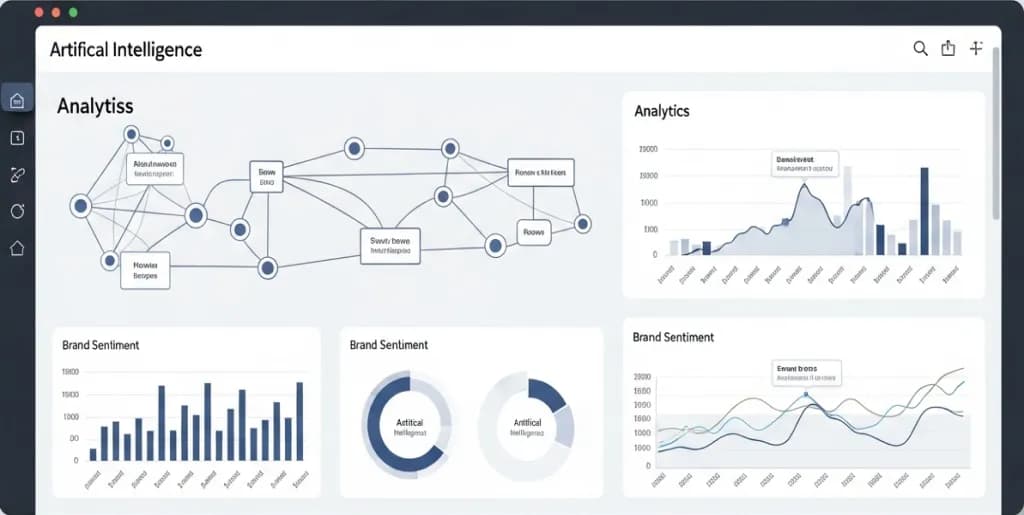
AI brand mentions tracking means measuring whether systems like ChatGPT, Perplexity, Copilot, and Google AI Overviews mention your brand when users ask category, comparison, or problem-solving questions. The goal is not just to count mentions, but to understand coverage, framing, and competitive context.
That matters because many discovery journeys now begin inside AI-generated answers. If your brand is missing from those responses, or described inaccurately, you lose visibility before the user ever reaches a search result or review site.
This guide explains how to build a reliable monitoring process for AI brand mentions and how to turn those observations into action.
Quick takeaways
- Track whether your brand appears, how often it appears, and how it is described.
- Use consistent prompt sets over time so changes in visibility are measurable.
- The most useful output is not a raw mention count but a repeatable share-of-voice view by query type.
Why AI Brand Mentions Matter
Generative AI platforms synthesize information from vast datasets to deliver definitive answers. Unlike traditional search engines that provide a list of links, answer engines provide direct recommendations. This single-answer paradigm creates a winner-takes-all environment for brand visibility.
If an AI model does not include your product in its output, the user is highly unlikely to discover you through that query. Traditional search engine optimization focuses on ranking URLs. AI brand mentions tracking focuses on entity association and context within neural networks. You must monitor these systems to ensure your brand narrative remains accurate and prominent.
The Shift from Search to Synthesis
Traditional search relies on keyword matching and backlink authority. Generative AI relies on semantic understanding and entity relationships. When a user asks an AI to compare software platforms, the model generates a response based on its training data and real-time retrieval capabilities.
This synthesis process obscures the original sources of information. Users trust the AI's synthesized answer as an objective truth. If the model associates your brand with outdated pricing, deprecated features, or negative sentiment, that misinformation becomes the user's reality. Tracking these outputs allows you to identify and correct narrative discrepancies.
Impact on the Buyer Journey
The modern buyer journey heavily incorporates AI research. B2B buyers and consumers use tools like ChatGPT, Claude, and Perplexity to build shortlists, compare features, and summarize reviews. These platforms act as autonomous researchers, filtering out brands that lack strong digital footprints.
Monitoring your presence in these early-stage research queries is vital. A drop in traditional organic traffic often correlates with a rise in zero-click AI searches. By tracking how models respond to category-level queries, you can measure your true top-of-funnel visibility. You must adapt your measurement strategies to account for this invisible traffic.
Real-World Observation: The Cost of AI Invisibility
Consider the case of a mid-size cybersecurity SaaS company that observed a sudden 15% decline in qualified inbound leads. Traditional search rankings remained stable, and website traffic showed only a minor dip. The marketing team initiated a manual audit of generative AI platforms.
They discovered that Perplexity and ChatGPT were consistently recommending three newer competitors for the query "best zero-trust network access for mid-market." The AI models were prioritizing competitors who had recently published extensive, highly structured comparison guides. The SaaS company was effectively erased from the AI-generated shortlists. This observation validated the immediate need for continuous AI mention monitoring.
Setting Up a Tracking Framework
You cannot improve what you do not measure. Establishing a robust tracking framework requires careful planning and precise execution. You must define exactly what you are looking for before you begin querying the models.
A successful framework relies on consistency. You need to test the same inputs across the same models at regular intervals. This systematic approach isolates variables and highlights genuine shifts in the AI's perception of your brand.
Step 1: Define Your Brand Entities
AI models do not understand brands as abstract concepts; they understand them as entities. An entity is a distinct, well-defined concept with specific attributes. You must map out every entity associated with your organization.
Create a comprehensive list of your primary and secondary entities. Do not limit this list to your company name. Broaden your scope to capture the full ecosystem of your brand.
- Corporate identities: Your official company name, common abbreviations, and historical names.
- Product lines: Specific software names, hardware models, and proprietary feature sets.
- Key personnel: The names of your CEO, founders, and prominent subject matter experts.
- Proprietary concepts: Unique methodologies, branded frameworks, or specific industry terms you coined.
- Known misspellings: Common typographical errors associated with your brand or products.
Step 2: Map the AI Ecosystem
Not all generative AI models operate the same way. They utilize different training data, different guardrails, and different retrieval mechanisms. You must track your brand across a diverse set of platforms to gain a complete picture.
Select the models that align with your target audience's behavior. Prioritize platforms that offer real-time web browsing capabilities alongside static training data.
- ChatGPT (OpenAI): The market leader. Test both the standard model and the web-browsing enabled versions.
- Claude (Anthropic): Known for large context windows and nuanced reasoning. Highly relevant for B2B and technical queries.
- Gemini (Google): Integrated deeply into the Google ecosystem. Crucial for understanding the future of Google Search.
- Perplexity AI: A dedicated answer engine that heavily relies on real-time web retrieval and citations.
- Microsoft Copilot: Integrated into Bing and enterprise software. Essential for tracking visibility among corporate users.
Step 3: Develop a Prompt Matrix
A prompt matrix is a structured grid of queries designed to elicit specific types of responses from AI models. You must standardize your prompts to ensure accurate tracking over time. Randomly asking an AI about your brand will yield inconsistent, unusable data.
Categorize your prompts based on user intent. This mirrors traditional keyword research but adapts it for conversational interfaces. Build a spreadsheet to document and track these prompts.
Navigational Prompts
These prompts test the AI's baseline knowledge of your brand. They determine if the model knows who you are and what you do.
- "What is [Brand Name]?"
- "Summarize the core offerings of [Brand Name]."
- "Who is the CEO of [Brand Name]?"
- "Where is [Brand Name] headquartered?"
Informational Prompts
These prompts assess how the AI explains your specific features, pricing, or use cases. They reveal the accuracy of the model's detailed knowledge.
- "How does [Product Name] handle data encryption?"
- "What is the pricing structure for [Brand Name] enterprise tier?"
- "Explain the onboarding process for [Brand Name]."
- "What are the main limitations of [Product Name]?"
Comparative Prompts
These prompts are the most critical for revenue generation. They test how the AI positions you against your direct competitors.
- "Compare [Brand Name] and [Competitor Name] for small businesses."
- "What are the advantages of [Brand Name] over [Competitor Name]?"
- "Which is better for marketing automation: [Brand Name] or [Competitor Name]?"
- "List the top alternatives to [Competitor Name]." (Monitor if your brand appears).
Category/Transactional Prompts
These prompts simulate a buyer looking for a solution without a specific vendor in mind. They measure your unprompted share of voice.
- "What are the best [Industry Category] software tools?"
- "Recommend a [Product Category] solution for a mid-size healthcare company."
- "Top 5 vendors for [Specific Service]."
- "Which [Product Category] offers the best return on investment?"
Step 4: Establish a Testing Protocol
Manual testing requires strict adherence to protocol to prevent skewed results. AI models personalize outputs based on user history and session context. You must eliminate these variables to capture objective data.
Always conduct manual tests in a clean environment. Use incognito or private browsing windows. Do not log into your personal or corporate accounts unless testing specific enterprise features.
- Clear the context window: Start a completely new chat session for every single prompt. Do not ask follow-up questions in the same thread unless you are specifically testing conversational memory.
- Disable chat history: If the platform allows, turn off chat history and model training features to prevent your testing from influencing future outputs.
- Record metadata: Document the exact date, time, model version (e.g., GPT-4o, Claude 3.5 Sonnet), and the exact text of the prompt used.
- Capture the output: Save the complete text response. Take screenshots of the output, especially if it includes formatting, tables, or specific citations.
Using Enterprise Tools for AI Tracking
Manual tracking is sufficient for establishing baselines, but it does not scale. As your prompt matrix grows and the AI ecosystem expands, manual execution becomes a massive drain on resources. You must transition to enterprise tools to automate this process.
The market for AI tracking software is rapidly evolving. Traditional social listening platforms are retrofitting their tools, while native AI tracking startups are emerging. You must evaluate these tools based on their specific capabilities for generative AI.
Evaluating Tool Capabilities
Do not confuse traditional brand monitoring with AI brand mentions tracking. A tool that scrapes Twitter and news sites will not tell you what ChatGPT is recommending in a private chat interface. You need tools specifically designed to query and analyze Large Language Models.
Look for platforms that offer direct API integrations with the major AI providers. The tool must be able to programmatically send your prompt matrix to multiple models simultaneously.
- Multi-model support: The tool must track across OpenAI, Anthropic, Google, and Perplexity at a minimum.
- Automated scheduling: You need the ability to run your prompt matrix daily, weekly, or monthly without manual intervention.
- Version control tracking: The tool should note which version of an LLM generated the response, as model updates drastically alter outputs.
- Citation analysis: For RAG-based engines like Perplexity, the tool must track which URLs the AI cites when mentioning your brand.
- Geographic simulation: The ability to simulate queries from different regions, as some models alter responses based on IP location.
Setting Up the Automated Workflow
Once you procure an enterprise tool, you must configure it to mirror your manual framework. Do not rely on the tool's default settings. Customize the tracking parameters to fit your specific entity definitions and prompt matrix.
Begin by importing your entity list. Ensure you configure the tool to recognize exact matches and semantic variations. If your brand name is a common dictionary word (e.g., "Apple" or "Target"), you must apply strict contextual filters to prevent false positives.
Upload your prompt matrix into the tool's scheduling engine. Group your prompts by intent category. Set the frequency of the tracking runs. Category-level prompts should be tracked weekly, as they fluctuate often. Navigational prompts can be tracked monthly to monitor baseline accuracy.
Leveraging API Integrations for Custom Tracking
If commercial tools do not meet your specific requirements, you can build a custom tracking solution using APIs. This approach requires engineering resources but offers unparalleled control over the tracking methodology.
You can write Python scripts that utilize the OpenAI and Anthropic APIs. These scripts can iterate through your prompt matrix, send the queries to the respective models, and log the responses into a structured database like PostgreSQL or Google BigQuery.
When building a custom solution, you must manage API costs carefully. Set strict token limits for your automated queries. Design your database schema to parse and store the generated text, the model version, the latency, and the prompt ID. This structured data forms the foundation for advanced sentiment analysis.
Analyzing the Sentiment of AI Mentions
Analyzing sentiment in generative AI outputs requires a different approach than traditional social media analysis. Social media posts are often highly emotional and explicitly positive or negative. AI models, by design, aim for a neutral, objective, and authoritative tone.
You cannot rely on simple keyword-matching sentiment analyzers. An AI might use entirely neutral vocabulary while systematically dismantling your product's value proposition. You must analyze the contextual sentiment and the implicit recommendations within the text.
The Nuances of AI Sentiment
AI models are trained to avoid hyperbole. They rarely use words like "terrible" or "amazing." Instead, they use comparative framing. You must train your team—or configure your tracking tools—to recognize this subtle framing.
An AI might state, "Brand X is a functional tool for basic needs, but Brand Y offers superior scalability for enterprise users." A traditional sentiment tool might score this as "Neutral." However, in the context of an enterprise buyer, this is a highly negative mention. It actively disqualifies your brand for that specific use case.
Categorizing Mention Types
To accurately analyze sentiment, you must categorize the nature of the mention. Break down the AI's response into specific classifications. This structured approach allows you to quantify qualitative text.
- Primary Recommendation: The AI lists your brand as the first or best option for a specific query. This is the highest value positive mention.
- Included Alternative: The AI lists your brand alongside competitors but does not highlight it as the primary choice. This is a neutral-positive mention.
- Factual Recitation: The AI accurately describes your features or pricing without offering an opinion or comparison. This is a strictly neutral mention.
- Omission: The AI completely fails to mention your brand in a category where you are a major player. This is an implicit negative mention.
- Qualified Warning: The AI mentions your brand but explicitly highlights a limitation, high cost, or missing feature. This is an explicit negative mention.
Detecting and Managing Hallucinations
Generative AI models occasionally invent facts. These fabrications, known as hallucinations, pose a severe risk to your brand reputation. Your tracking framework must actively scan for false information.
Hallucinations often occur regarding pricing, integrations, and historical controversies. An AI might confidently state that your software lacks a crucial API integration that you launched three years ago. It might invent a data breach that never happened.
When analyzing outputs, cross-reference the AI's claims against your internal knowledge base. Flag any factual inaccuracies immediately. Document the specific prompt that triggered the hallucination and the exact wording the model used. You will need this data to formulate a correction strategy later.
Scoring the "Recommendation Engine" Factor
The ultimate goal of sentiment analysis in this context is to determine your "Recommendation Score." This is a custom metric you must develop to quantify how often an AI advocates for your brand.
Assign a point value to the mention categories. For example: Primary Recommendation (+3), Included Alternative (+1), Omission (0), Qualified Warning (-2). Calculate the average score across your comparative and transactional prompts. This score provides a tangible KPI to track the effectiveness of your AI optimization efforts over time.
Reporting on AI Brand Mentions
Data collection is useless without effective communication. You must translate the raw outputs of AI models into actionable business intelligence. Your reporting structure must cater to different stakeholders, from content marketers to the C-suite.
Do not simply dump raw AI transcripts into a document. You must synthesize the data, highlight trends, and provide strategic recommendations. Build a reporting cadence that aligns with your organization's broader marketing reviews.
Building an AI Visibility Dashboard
Create a centralized dashboard to visualize your tracking data. Use business intelligence tools like Tableau, Looker Studio, or PowerBI. Connect these tools to the database where your enterprise tracking software or custom API scripts store their results.
Design the dashboard for immediate scannability. Stakeholders should be able to understand the brand's AI posture within five seconds of viewing the dashboard.
Include these critical visualizations:
- Share of Voice (SOV) in AI: A pie chart showing how often your brand is mentioned versus competitors across category-level prompts.
- Sentiment Trend Line: A line graph tracking your custom Recommendation Score over the past six months.
- Model Breakdown: A bar chart comparing your visibility on ChatGPT versus Claude versus Perplexity.
- Hallucination Alert Log: A prominent table listing any active factual inaccuracies detected in the latest tracking run.
Key Metrics to Track
Standardize the metrics you report on. Consistency in reporting builds trust in the data. Define these metrics clearly in a glossary attached to your reports, as these concepts will be new to many stakeholders.
Focus on metrics that directly correlate to brand health and potential revenue impact.
- Prompt Presence Rate: The percentage of relevant category prompts where your brand appears in the output.
- Feature Accuracy Score: A percentage representing how often the AI correctly identifies your core features without hallucination.
- Citation Frequency: For RAG models, the number of times your owned domains are cited as source material in the AI's response.
- Competitor Co-occurrence: The specific competitors most frequently mentioned alongside your brand in comparative queries.
Structuring the Monthly Report
Deliver a comprehensive report on a monthly basis. This frequency allows enough time for model updates or your optimization efforts to reflect in the data. Structure the report to drive action.
Start with an Executive Summary. Highlight the most significant changes in Share of Voice and flag any critical hallucinations. Keep this section under three paragraphs.
Follow with the Competitive Landscape section. Detail how your competitors are faring in the models. If a competitor suddenly dominates the recommendations in Claude, highlight this anomaly.
Conclude with the Action Items section. This is the most important part of the report. Translate the data into specific tasks for your marketing and PR teams.
Translating Data into Actionable Steps
Reporting must lead to optimization. When your tracking reveals a deficiency, you must deploy strategies to correct it. This practice is often referred to as Generative Engine Optimization (GEO) or LLM Optimization (LLMO).
If the models consistently omit your brand from category queries, you must increase your digital footprint. AI models train on high-authority, structured data. You need to feed the ecosystem.
- Publish structured comparisons: Create detailed, objective comparison pages on your website. Use clear HTML tables and schema markup. Models ingest structured data more easily than dense paragraphs.
- Target third-party reviews: Models heavily weight aggregate review sites (G2, Capterra, Trustpilot) and authoritative industry publications. Launch campaigns to increase your presence on these platforms.
- Update digital PR assets: Ensure your Wikipedia page, Crunchbase profile, and official press releases are meticulously accurate and up-to-date. Models rely on these foundational data sources to establish entity facts.
- Address hallucinations directly: If a model hallucinates a missing feature, publish a dedicated blog post or documentation page specifically detailing that feature. Optimize it for traditional search to ensure the model's web-crawlers ingest the correction.
Advanced Strategies for AI Tracking
As your tracking framework matures, you must adopt advanced methodologies to stay ahead of the curve. The AI landscape evolves rapidly. Models receive continuous updates, and new architectures emerge regularly. Your tracking strategy must be dynamic.
Move beyond basic prompt matrices and explore complex analytical techniques. This will provide deeper insights into the latent associations within the neural networks.
Cross-LLM Comparison Methodologies
Do not treat all AI models as a monolith. You must analyze the discrepancies between them. A brand might be highly recommended by ChatGPT but completely ignored by Gemini. Understanding these variances is crucial for targeted optimization.
Implement a cross-LLM comparison protocol. Run the exact same prompt matrix across four different models simultaneously. Map the outputs side-by-side.
Look for patterns in the discrepancies. If Perplexity recommends you but Claude does not, it indicates a difference in their retrieval mechanisms. Perplexity relies heavily on recent news and web citations, while Claude relies more on its static training corpus. This insight tells you whether you need to focus on digital PR (for Perplexity) or long-form authoritative content (for Claude).
Prompt Engineering for Brand Audits
Refine your prompt engineering skills to extract deeper insights. Standard prompts yield standard answers. Advanced prompts force the model to reveal its underlying biases and associations regarding your brand.
Utilize persona-based prompting. Ask the AI to evaluate your brand from the perspective of different buyer personas.
- "Act as a Chief Information Security Officer. Evaluate the security posture of [Brand Name] based on your knowledge base."
- "Act as a startup founder with a limited budget. Why would you choose or reject [Brand Name]?"
Utilize zero-shot and few-shot prompting techniques to test the model's reasoning capabilities regarding your market positioning. Ask the model to categorize your brand without providing predefined categories. This reveals how the AI organically classifies your entity.
Future-Proofing Your Tracking Strategy
The mechanisms of AI search will continue to change. Search engines are integrating generative capabilities directly into their core interfaces (e.g., Google's AI Overviews). You must prepare your tracking framework to adapt to these hybrid models.
Stay informed about model update schedules. When OpenAI announces a new GPT version or Google updates its core algorithm, immediately run a full baseline test using your prompt matrix. Document the delta between the old model and the new model.
Invest in continuous education for your team. The terminology and technology surrounding generative AI shift constantly. Ensure your analysts understand concepts like RAG, vector databases, and semantic search. A technically proficient team is your best defense against algorithmic volatility.
By maintaining a rigorous, systematic approach to AI brand mentions tracking, you secure your brand's narrative. You transition from being a passive subject of AI synthesis to an active participant in the generative ecosystem. Execute these steps consistently to ensure your brand remains visible, accurate, and highly recommended in the answer engines of the future.
References
- OpenAI: Publishers and developers FAQ
- Google Search Central: About AI features and your website
- Anthropic: Web crawling and blocking guidance