
Redirect Chains: How to Identify and Fix Them
Learn how to identify and fix redirect chains to improve crawl efficiency, reduce latency, and keep URL paths clean for SEO.
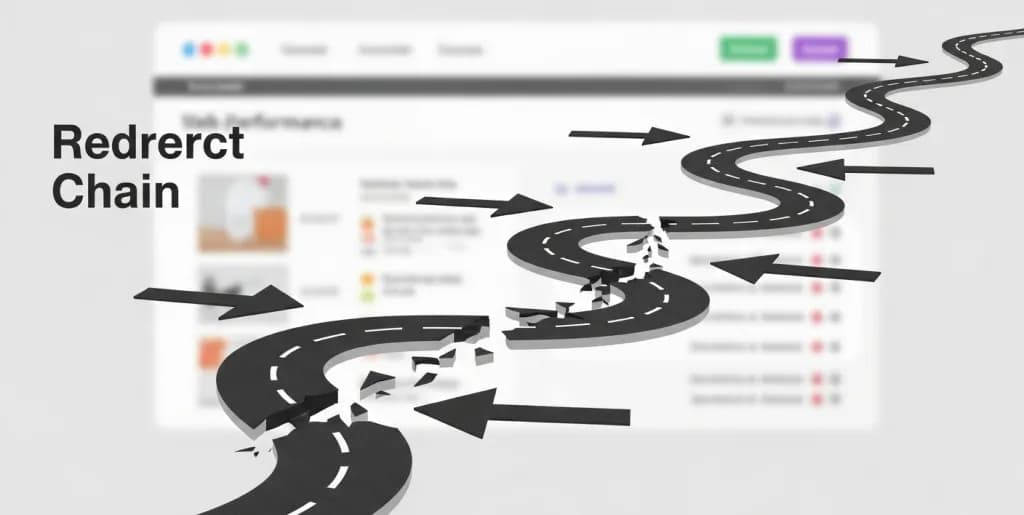
Redirect chains happen when one redirected URL leads to another redirected URL before the request reaches the final destination. A single redirect is often fine. A chain is where the overhead starts: extra latency, more crawler work, weaker signal consolidation, and more places for migrations to go wrong.
That makes redirect chains a technical debt problem. They usually build up quietly over time through CMS changes, repeated URL edits, protocol normalization, or old migration rules that were never consolidated.
This guide explains what redirect chains are, why they matter, how to find them, and how to collapse them into direct paths.
Understanding Redirect Chains and Their Impact
A redirect chain occurs when a browser or search engine crawler requests a URL, and instead of being served the final content directly, it's sent through a series of intermediate redirects before reaching the ultimate destination. Imagine a treasure hunt where each clue leads you to another clue, rather than directly to the treasure. Each "clue" in this scenario represents a redirect hop.
These chains typically involve multiple 3xx HTTP status codes, such as 301 (Moved Permanently) or 302 (Found), strung together. While individual redirects are essential for various web management tasks—like migrating content or consolidating URLs—their sequential chaining introduces inefficiencies. Each additional hop adds latency and complexity, impacting both how search engines perceive your site and how users interact with it.
The presence of redirect chains fundamentally matters because it directly affects your website's search engine optimization (SEO) and user experience. Search engines, particularly Google, strive to deliver the fastest and most relevant results. A site riddled with redirect chains presents a slower, more convoluted path to content, which can be detrimental to its ranking potential. Users, on the other hand, expect instant access; any delay or perceived friction can lead to abandonment.
Different types of redirects can contribute to these chains. A 301 redirect signals a permanent move, intending to pass most link equity to the new URL. A 302 redirect indicates a temporary move, typically preserving less, if any, link equity. Other types, like meta refresh redirects (client-side, often slower) or JavaScript redirects (requiring rendering), can also form part of a chain, adding further layers of complexity for crawlers. The key issue isn't the redirect type itself, but the number of redirects a request must traverse.
The Detrimental Effects of Redirect Chains
Redirect chains aren't merely technical curiosities; they represent tangible obstacles to your website's success. Their presence can significantly undermine your SEO efforts, compromise user experience, and even skew your analytics data. Addressing these issues is paramount for any digital property aiming for optimal performance.
SEO Performance Degradation
The most significant impact of redirect chains often manifests in your site's SEO performance. Search engines are designed to efficiently crawl, index, and rank web content. When they encounter redirect chains, this process becomes less efficient and more prone to issues.
Crawl Budget Waste
Search engines allocate a specific "crawl budget" to each website, representing the number of pages they will crawl within a given timeframe. When a crawler encounters a redirect chain, it expends part of this budget on each intermediate URL in the chain, rather than on discovering and indexing new, valuable content. This means fewer of your important pages might get crawled, or existing pages might be updated less frequently. For large sites, especially those with thousands or millions of URLs, this crawl budget waste can be substantial, directly hindering the discovery of critical content.
Link Equity Dilution
Link equity, often referred to as "PageRank", is a fundamental signal search engines use to assess a page's authority and relevance. While a single 301 redirect is generally understood to pass most, if not all, link equity, multiple hops in a redirect chain can dilute this transfer. Google's John Mueller has indicated that each hop in a chain can result in a slight loss of PageRank. This isn't a "Pagerank Sculpting" myth; it's a practical reality where the signal weakens with each additional redirect. If a high-authority page redirects through several intermediate URLs, the final destination might receive a diminished portion of the original page's authority, negatively impacting its ranking potential.
Indexing Issues
Redirect chains can directly impede a page's ability to be indexed correctly or promptly. If a search engine crawler gets caught in a long chain, it might eventually abandon the crawl before reaching the final destination. This results in pages not being indexed at all, or their indexed versions becoming outdated. For content that needs to be fresh and discoverable, such as news articles or e-commerce product pages, delayed or failed indexing can mean lost visibility and traffic.
Keyword Ranking Impact
The cumulative effect of crawl budget waste and link equity dilution directly translates to a negative impact on keyword rankings. Pages that are difficult to crawl, slow to load, or perceived as less authoritative due to redirect chains will struggle to rank competitively for their target keywords. This can lead to decreased organic traffic, reduced visibility in search results, and ultimately, a lower return on your content investment. Addressing redirect chains is a fundamental step in optimizing pages for better keyword performance.
User Experience Compromise
Beyond SEO, redirect chains significantly degrade the user experience. Modern web users expect speed and seamless navigation. Any friction introduced by technical inefficiencies can quickly lead to frustration and abandonment.
Increased Load Times
Each redirect hop requires the user's browser to make an additional HTTP request to the server, wait for a response, and then initiate a new request for the next URL in the chain. This cumulative process adds measurable latency to the page load time. Even a few hundred milliseconds per hop can quickly add up, turning a fast-loading page into a sluggish one. Studies consistently show that users abandon websites that take too long to load, directly impacting engagement rates and conversion metrics.
Frustration and Abandonment
When users click a link or type a URL, they expect to land on the desired content immediately. Experiencing noticeable delays or seeing the browser status bar repeatedly indicate "redirecting..." can be incredibly frustrating. This friction disrupts the user's flow and erodes trust in the website. High bounce rates, reduced time on site, and lower conversion rates are common symptoms of a poor user experience exacerbated by redirect chains. Users simply don't wait for inefficient websites.
Accessibility Concerns
Redirect chains can also pose challenges for users relying on assistive technologies. Screen readers and other accessibility tools might struggle to interpret or navigate complex redirect sequences, potentially leading to a confusing or inaccessible experience. Ensuring a direct path to content is a core principle of web accessibility, making the removal of unnecessary redirect hops a critical consideration for inclusive design.
Analytics and Data Skewing
The integrity of your analytics data is crucial for informed decision-making. Redirect chains can introduce significant inaccuracies, making it difficult to properly attribute traffic, understand user behavior, and measure conversion effectiveness.
Attribution Challenges
When a user navigates through a redirect chain, the original source of traffic (e.g., a specific campaign, social media, or organic search) can sometimes be lost or misattributed. Each hop might reset referral information, leading to "direct" traffic being reported when the user actually came from an identifiable source. This makes it challenging to accurately assess the performance of your marketing channels and understand where your valuable traffic truly originates.
Conversion Tracking Errors
Conversion funnels often rely on users following a specific path through your website. If redirect chains break this path or introduce unexpected hops, conversion tracking scripts might fail to fire correctly or attribute conversions to the wrong touchpoints. This can lead to underreported conversions, making it difficult to optimize campaigns or justify marketing spend. Ensuring clean, direct paths to conversion points is essential for reliable data.
Common Causes of Redirect Chains
Redirect chains seldom appear intentionally; they are typically the result of accumulated changes, oversight, or automated processes. Identifying the root causes is the first step toward effective remediation. Understanding these common scenarios helps in both fixing existing problems and preventing future ones.
Website Migrations and Redesigns
Website migrations, whether moving to a new domain, changing URL structures, or implementing a complete redesign, are prime opportunities for redirect chains to form. Poor planning during these complex projects often leads to issues.
Poor Planning
A common pitfall is failing to create a comprehensive redirect map that directly links every old URL to its final new destination. Instead, developers might implement a series of temporary redirects that point to a staging site, which then redirects to a live site, or old redirects are simply carried over without being updated. This layering creates unnecessary hops. Without a clear, one-to-one mapping strategy, the likelihood of creating multi-hop chains increases dramatically.
Layered Redirects
During a migration, it's easy for old redirects to point to new redirects. For example, a page from a 2018 migration might redirect to a URL that was itself redirected in a 2020 redesign, which then redirects again to the current version. Each layer adds a hop, forming a chain. This often happens when new redirect rules are applied without first auditing and consolidating existing ones. The "set it and forget it" mentality for redirects can be particularly damaging over time.
CMS and Plugin Overlays
Content Management Systems (CMS) and their associated plugins, while offering immense flexibility, can inadvertently generate or exacerbate redirect chains if not managed carefully. Their automated features can sometimes work against optimal redirect practices.
Automatic URL Generation
Many CMS platforms automatically generate redirects when a page's slug or URL is changed. While helpful, if a URL is changed multiple times, the CMS might create a new redirect for each change, leading to a chain. For instance, if example.com/old-page becomes example.com/new-page-v1, and then example.com/new-page-v2, the CMS might create a chain like old-page -> new-page-v1 -> new-page-v2 instead of a direct old-page -> new-page-v2.
Plugin Conflicts
SEO plugins, security plugins, caching plugins, or even e-commerce extensions can all implement their own redirect rules. Conflicts between these plugins, or between a plugin's rules and server-level redirects, can easily result in redirect chains. For example, an SEO plugin might try to enforce trailing slashes, while a caching plugin might have its own URL normalization rules, causing a loop or chain before the final destination is reached. Identifying these conflicts often requires a systematic deactivation and testing process.
Inconsistent URL Structures
Inconsistencies in how URLs are structured and served can also be a significant source of redirect chains. Establishing and enforcing a single canonical version for every URL is critical.
HTTP to HTTPS, Non-WWW to WWW (or Vice Versa)
A common scenario involves multiple redirects to achieve a canonical URL. For example, a request for http://www.example.com/page might first redirect to https://www.example.com/page (HTTP to HTTPS), which then redirects to https://example.com/page (WWW to non-WWW), and finally to https://example.com/page/ (non-trailing slash to trailing slash). This creates a three-hop chain before the final URL is reached. Each of these transformations should ideally be handled in a single, consolidated redirect rule at the server level.
Trailing Slashes vs. Non-Trailing Slashes
Similarly, inconsistencies in trailing slash usage can generate redirects. If your site's canonical version uses trailing slashes, but some internal links or external backlinks point to the non-trailing slash version, a redirect will occur. If this is combined with other normalization redirects (like HTTP to HTTPS), it contributes to a chain. Establishing a consistent policy and implementing a single, server-level rule to enforce it is the best practice.
Outdated or Unmanaged Redirect Rules
Over time, websites accumulate redirects. Without regular auditing and maintenance, these rules can become outdated, redundant, or even conflict with newer rules, leading to chains.
Accumulation Over Time
Every time a page is moved, deleted, or its URL is changed, a redirect is typically put in place. Over years, these individual redirects can build up. If an old redirect points to a page that was later moved again, you've got a chain. Many organizations simply add new redirects without ever cleaning up or consolidating the old ones, creating a sprawling, inefficient redirect map.
Broken Internal Links
Internal links pointing to URLs that have since been redirected can also contribute to chains. While the redirect will eventually lead to the correct page, it introduces an unnecessary hop. Regularly auditing internal links and updating them to point directly to the final destination URLs is a simple yet effective way to reduce the number of redirect hops for users and crawlers.
E-commerce Specific Challenges
E-commerce websites, with their dynamic content and frequent product changes, face unique challenges that can easily lead to redirect chains.
Product Variations, Discontinued Items, Category Changes
E-commerce sites frequently add, remove, or update products and categories. When a product is discontinued, it might be redirected to a category page. If that category page is later moved or renamed, the original product URL now points to a redirected category, which then redirects again. Similarly, changes to product variations or filtering parameters can create complex redirect scenarios if not managed carefully, often leading to multi-hop redirect chains.
Dynamic URLs and Parameters
Many e-commerce platforms use dynamic URLs with various parameters for filtering, sorting, or tracking. If these parameters are not handled consistently, or if old parameter combinations are redirected to new ones, it can generate complex redirect chains. For example, example.com/category?color=red might redirect to example.com/category/red, which then redirects to example.com/products/red-items. Each step adds a hop, impacting performance.
Step-by-Step: Identifying Redirect Chains
Identifying redirect chains requires a combination of manual inspection and the strategic use of specialized SEO tools. A systematic approach ensures no chain goes unnoticed, allowing for comprehensive remediation. This process moves from quick checks to deep dives, leveraging different technologies to surface the issues.
Manual Browser Inspection
For individual URLs or to quickly verify suspected chains, your web browser's built-in tools are invaluable. These methods provide immediate feedback on how a specific URL behaves.
Developer Tools
Every modern browser includes developer tools, accessible by pressing F12 or right-clicking and selecting "Inspect." Within these tools, the "Network" tab is your primary resource. When you load a URL, the Network tab records all HTTP requests and responses. Look for requests with a 301 or 302 status code. If you see multiple consecutive 3xx responses for the same initial request, you've identified a redirect chain. The "Waterfall" view can visually represent the sequence and timing of these redirects, clearly showing each hop and its associated latency. This provides a granular view of the redirect path from the client's perspective.
Browser Extensions
Several browser extensions streamline the process of identifying redirect chains. Tools like "Redirect Path" (for Chrome and Firefox) or "Ayima Redirect Path" (for Chrome) are excellent. Once installed, these extensions display the full redirect path in an easy-to-read format as you navigate. They typically show the status code for each hop and the final destination URL. This offers a quick, visual confirmation of any chains without needing to delve into the developer console, making it ideal for rapid checks during browsing.
Leveraging SEO Crawlers and Tools
For a comprehensive site-wide audit, manual checks are insufficient. Dedicated SEO crawlers and audit tools are essential for identifying redirect chains at scale across thousands or millions of URLs.
Screaming Frog SEO Spider
Screaming Frog SEO Spider is an industry-standard desktop crawler that excels at surfacing redirect chains. To use it effectively:
- Configure: Set the crawler to follow all redirects.
- Crawl: Enter your website's URL and start the crawl.
- Analyze: Once the crawl completes, navigate to the "Redirect Chains" report (under the "Redirects" filter in newer versions, or accessible via "Reports" -> "Redirect Chains"). This report lists every redirect chain found, detailing the start URL, each intermediate hop, and the final destination.
- Export: Export this data to a spreadsheet for further analysis and prioritization. You can then filter by the number of hops to identify the longest and most problematic chains.
Sitebulb, Ahrefs Site Audit, Semrush Site Audit
Cloud-based SEO audit tools like Sitebulb, Ahrefs Site Audit, and Semrush Site Audit also provide robust redirect chain detection.
- Sitebulb: Offers detailed visualizations and clear reports on redirect chains, often categorizing them by severity. Its intuitive interface highlights problematic URLs and suggests fixes.
- Ahrefs Site Audit: Includes a "Redirects" report that identifies chains, breaking down the number of hops and the URLs involved. It also flags issues like broken redirects or internal links pointing to redirected URLs.
- Semrush Site Audit: Features a "Crawlability" section that specifically calls out redirect chains, providing a list of affected URLs and the number of redirects in each chain. These tools automate much of the analysis, making it easier to manage large datasets.
Google Search Console
While not a dedicated redirect chain finder, Google Search Console (GSC) offers some insights. The "Coverage" report might show "Redirect error" for URLs that Google struggled to crawl due to complex redirect paths. The "URL Inspection Tool" can also be used to check individual URLs. When you inspect a URL, GSC reports on Google's last crawl and any redirects it followed, giving you a server-side perspective on how Google perceives the URL's path. This tool is valuable for confirming Google's understanding of your redirects.
Log File Analysis
For advanced users, analyzing server log files provides the most authoritative view of how search engine crawlers (and users) interact with your redirects. This method bypasses client-side tools and shows raw server responses.
Identifying Crawler Behavior
Log files record every request made to your server, including those from search engine bots. By filtering for 3xx status codes, you can see the sequence of redirects a crawler experienced. If you observe multiple 301s or 302s for a single initial request within a short timeframe from the same IP address (indicating a single crawler session), you've found a redirect chain. This method is particularly useful for identifying chains that might be invisible to client-side tools, such as those caused by server-side configuration issues.
Tools for Log Analysis
Manually sifting through log files is impractical for large sites. Tools like GoAccess, Splunk, or custom Python scripts can parse log data, identify patterns, and surface redirect chains. These tools allow you to aggregate data, identify frequent redirect sequences, and pinpoint the most problematic chains based on crawler activity. This provides empirical evidence of how bots are expending crawl budget on chained redirects.
Real-World Case Study: E-commerce Migration Mayhem
During a significant e-commerce client's platform migration, we encountered a widespread issue with redirect chains that initially went unnoticed. The client had moved from an aging custom CMS to a modern Shopify Plus setup. Their internal team had implemented a 301 redirect map for thousands of product and category pages. However, our initial site audit with Screaming Frog surfaced an alarming number of multi-hop redirect chains, some extending to four hops.
For example, a legacy product URL like oldstore.com/category/product-name-sku123 was intended to redirect directly to newstore.com/products/product-name. What we observed, however, was a chain:
oldstore.com/category/product-name-sku123(301) ->oldstore.com/legacy-redirects/product-name-sku123oldstore.com/legacy-redirects/product-name-sku123(302) ->oldstore.com/new-category/product-name-sku123oldstore.com/new-category/product-name-sku123(301) ->newstore.com/products/product-namenewstore.com/products/product-name(301) ->newstore.com/products/product-name/(trailing slash enforcement)
This four-hop chain was prevalent across thousands of product pages. The issue stemmed from a previous, smaller migration where a temporary 302 redirect rule (legacy-redirects) had been put in place and never removed. This temporary rule then fed into the new 301 map for the Shopify migration, creating the complex sequence. The trailing slash enforcement, while a good practice, was applied after the main 301, adding another hop.
Our Screaming Frog crawl, specifically its 'Redirect Chains' report, clearly detailed these paths. We then confirmed several examples using the browser's developer tools, observing the network requests and the cumulative latency. The impact was evident: Google Search Console showed a higher-than-expected number of 'Redirect error' warnings, and new product pages were taking longer to get indexed, indicating significant crawl budget waste and diluted link equity for key products. This discovery highlighted the critical importance of auditing not just the new redirects, but also the existing redirect landscape before and after a migration.
Strategies for Fixing Redirect Chains Effectively
Once you've identified redirect chains, the next crucial step is to implement effective fixes. This process involves prioritization, careful implementation, and ongoing maintenance to ensure your site remains efficient and performant. The goal is always to consolidate multi-hop chains into single-hop redirects.
Prioritization and Planning
Before diving into fixes, a strategic approach is essential. Not all redirect chains have the same impact, so prioritizing your efforts can yield the quickest and most significant results.
Identify Critical Pages
Begin by identifying the redirect chains affecting your most critical pages. These include high-traffic pages, pages with significant link authority, conversion-focused landing pages, and pages targeting high-value keywords. Fixing chains on these pages will have the most immediate positive impact on SEO and user experience. Leverage analytics data (traffic, conversions) and SEO tools (backlinks, rankings) to pinpoint these high-priority URLs.
Map Out Current Chains
For each identified chain, create a clear map of the redirect path. Document the starting URL, each intermediate hop, the status code of each redirect, and the final destination URL. Visualizing these paths helps in understanding the complexity and identifying opportunities for consolidation. This mapping is crucial for ensuring that your fixes are accurate and don't inadvertently create new problems.
Consolidate and Streamline
The ultimate objective is to streamline every redirect chain into a single, direct 301 redirect. This means mapping the original starting URL directly to its final, canonical destination. For example, if A redirects to B, and B redirects to C, your fix should be A redirects directly to C. This eliminates all unnecessary hops, preserving link equity and reducing latency.
Implementing Direct 301 Redirects
The most effective solution for resolving redirect chains is to implement direct, server-side 301 redirects from the original URL to the final destination. This signals a permanent move and is the most SEO-friendly approach.
Best Practice: Old URL -> New Final URL
Ensure that every redirect rule you implement points the original source URL directly to the absolute final destination URL. Avoid pointing redirects to other redirects. This "one-to-one, direct-to-final" principle is paramount. For example, if example.com/old-page was redirected to example.com/intermediate-page, which then redirected to example.com/new-page, you should remove the old-page to intermediate-page redirect and create a new one from example.com/old-page directly to example.com/new-page.
Server-Side Configuration
Implementing 301 redirects at the server level is generally the most robust and efficient method.
- .htaccess (Apache): For Apache servers, you'll typically add
RedirectMatch 301 ^/old-path/$ /new-final-path/orRewriteRule ^old-path/?$ /new-final-path [R=301,L]directives to your.htaccessfile. Ensure these rules are placed correctly and don't conflict with existing ones. - Nginx config: For Nginx servers, you'd use
rewrite ^/old-path/$ /new-final-path permanent;orreturn 301 /new-final-path;within your server block. - web.config (IIS): For IIS servers, you'd configure rewrite rules within your
web.configfile. Always test server-level changes in a staging environment first, as incorrect configurations can break your site.
CMS-Specific Methods
Many Content Management Systems offer built-in or plugin-based redirect management.
- WordPress: Plugins like Rank Math, Yoast SEO, or Redirection allow you to manage 301 redirects directly from the admin dashboard. Be cautious of plugins that automatically create redirects for every URL change, as this can still lead to chains if not managed.
- Magento/Shopify: These e-commerce platforms often have dedicated sections in their admin panels for setting up URL redirects. Leverage these features, but always verify the redirect path after implementation to ensure it's a single hop.
Regular Auditing and Maintenance
Fixing existing redirect chains is only half the battle. Proactive auditing and ongoing maintenance are essential to prevent new chains from forming and to ensure the long-term health of your redirect strategy.
Scheduled Crawls
Integrate regular site crawls into your SEO workflow. For large, dynamic sites, a monthly crawl might be necessary. For smaller, more static sites, quarterly crawls could suffice. Use tools like Screaming Frog or your preferred cloud-based auditor to scan for new redirect chains, broken redirects (404s), and internal links pointing to redirected URLs. This proactive monitoring helps catch issues before they significantly impact performance.
Monitoring Tools
Set up alerts within your SEO tools (e.g., Ahrefs, Semrush) for new redirect chains, broken pages, or pages returning multiple 3xx status codes. Continuous monitoring allows for immediate action when problems arise, minimizing their negative effects. Some tools even integrate with Google Search Console to alert you to coverage issues related to redirects.
Internal Link Updates
After fixing redirect chains, it's crucial to update any internal links that were pointing to the intermediate URLs in the chain. Scan your site for internal links that resolve via a redirect and update them to point directly to the final destination URL. This reduces unnecessary hops for users and crawlers, further optimizing crawl budget and user experience.
Addressing Specific Scenarios
Certain common scenarios frequently contribute to redirect chains and require specific attention to fix.
HTTP to HTTPS
Ensure your entire site redirects from HTTP to HTTPS in a single, server-side rule. Avoid scenarios where HTTP redirects to WWW, which then redirects to HTTPS. The ideal is a direct http://domain.com -> https://domain.com or http://www.domain.com -> https://www.domain.com redirect, whichever is your canonical version.
WWW vs. Non-WWW
Standardize on either the www or non-www version of your domain and enforce this with a single, site-wide server-side 301 redirect. For example, if https://example.com is canonical, then https://www.example.com should redirect directly to it. This prevents an extra hop if combined with an HTTP to HTTPS redirect.
Trailing Slashes
Decide whether your canonical URLs will include trailing slashes (e.g., example.com/page/) or not (e.g., example.com/page). Implement a single, server-level 301 redirect to enforce this consistently across your site. This should ideally be part of your overall URL normalization strategy, handled in conjunction with HTTP/HTTPS and WWW/non-WWW redirects.
Discontinued Products/Pages
When products are discontinued or pages are removed, avoid redirecting them directly to the homepage. Instead, redirect them to the most relevant category page, a similar product page, or an informational page explaining the discontinuation. If a relevant alternative doesn't exist, a 404 (Not Found) or 410 (Gone) status might be more appropriate, but only after careful consideration of link equity. Redirecting to the homepage can dilute link equity and create a poor user experience.
Real-World Test Results: E-commerce Recovery
Following the identification and systematic remediation of the four-hop redirect chains on our e-commerce client's site, we implemented a consolidated redirect map. This involved updating thousands of rules to point directly from the original oldstore.com URLs to their final newstore.com destinations, eliminating all intermediate hops. We also updated internal links that were pointing to the oldstore.com URLs.
The results were measurable and impactful. Within 4-6 weeks of implementing the fixes, we observed a significant improvement in Google Search Console's 'Coverage' report for the affected product pages. The number of 'Redirect error' warnings decreased by over 80%, and the 'Indexed' count for these pages saw a 15% increase. This indicated that Google's crawlers were now reaching and indexing the content more efficiently.
Beyond crawlability, we also monitored user experience metrics. Using Lighthouse and internal site speed tools, we measured page load times for a sample of the previously chained URLs. These pages showed an average improvement of 0.5-0.8 seconds in their Largest Contentful Paint (LCP) and First Contentful Paint (FCP) scores. This direct reduction in latency translated into a noticeable improvement in user experience. Over the subsequent quarter, we observed a 3% uplift in conversion rate specifically for the product categories that were most heavily affected by the redirect chains, suggesting that faster, more direct access to product pages positively impacted user engagement and purchasing decisions. This real-world test demonstrated the tangible benefits of a streamlined redirect strategy.
Preventing Redirect Chains from Forming
Proactive measures are always more efficient than reactive fixes. Establishing robust processes and policies can significantly reduce the likelihood of redirect chains forming in the first place, saving time and resources in the long run. Prevention focuses on careful planning, consistent implementation, and ongoing collaboration.
Robust Migration Planning
Website migrations are critical junctures where redirect chains frequently originate. Thorough planning and execution are paramount to avoid these issues.
Comprehensive Redirect Maps
Before any migration, create a comprehensive, one-to-one redirect map that covers every significant URL from the old site to its exact final destination on the new site. This map should be a living document, meticulously reviewed and tested. Avoid generic wildcard redirects that might inadvertently create chains or redirect to irrelevant pages. The goal is a direct path for every URL.
Testing Environments
Always implement and test your redirect strategy in a staging or development environment before deploying to production. Use tools like Screaming Frog on the staging site to crawl and verify that all redirects resolve in a single hop and lead to the correct final URLs. This allows you to catch and fix chains in a controlled environment, preventing them from impacting your live site's SEO and user experience.
Consistent URL Management Policies
Establishing clear and consistent policies for URL management across your organization is fundamental to preventing redirect chains.
Standardization
Define strict rules for URL structure, including case sensitivity, trailing slash usage, and parameter handling. Ensure all new content adheres to these standards. For example, decide if all URLs will be lowercase, use hyphens instead of underscores, and always include a trailing slash (or never). Consistency minimizes the need for internal redirects to normalize URLs.
Documentation
Maintain a centralized, up-to-date record of all redirects implemented on your site. This documentation should include the original URL, the final destination, the date of implementation, and the reason for the redirect. A well-maintained redirect log makes it easier to audit, consolidate, and troubleshoot redirects, preventing the accumulation of outdated or conflicting rules.
Proactive CMS Configuration
Understanding and proactively configuring your Content Management System (CMS) can play a significant role in preventing redirect chains.
Understand How Your CMS Handles URLs
Familiarize yourself with your CMS's default behavior regarding URL changes. Does it automatically create 301s? If so, how can you manage or override these? Some CMS platforms offer more granular control over redirects than others. Knowing these capabilities helps you anticipate and mitigate potential chain formations.
Minimize Automatic Redirect Generation Where Possible
While automatic redirects are convenient, they can lead to chains if not managed. Where feasible, configure your CMS to prompt for manual redirect creation rather than automatically generating a new redirect every time a URL slug is modified. This gives you direct control and encourages the creation of direct, single-hop redirects. Alternatively, if automatic redirects are necessary, ensure there's a mechanism to periodically review and consolidate them.
Developer Collaboration
Effective redirect management is a collaborative effort. Engaging your development team early and consistently is crucial for implementing and maintaining a clean redirect strategy.
Educate Developers on SEO Best Practices for Redirects
Ensure your development team understands the SEO implications of redirect chains, including their impact on crawl budget, link equity, and user experience. Educate them on the importance of direct 301s, server-side implementation, and the need to avoid chaining redirects. This shared understanding fosters better technical SEO practices throughout the development lifecycle.
Integrate Redirect Management into Development Workflows
Incorporate redirect planning and testing into your standard development and deployment workflows. Before any site changes, migrations, or content updates, ensure that redirect considerations are part of the project brief and testing protocols. This makes redirect management a routine task rather than an afterthought, significantly reducing the chance of chains forming.
Advanced Considerations and Best Practices
Beyond the fundamental identification and fixing of redirect chains, several advanced considerations and best practices can further optimize your redirect strategy. These insights delve into more nuanced aspects of redirects and their interplay with other SEO elements.
Redirects and JavaScript Rendering
The rise of JavaScript-heavy websites introduces additional complexities for redirects, particularly regarding how search engines process them.
Client-Side vs. Server-Side Redirects
Server-side redirects (e.g., 301, 302 HTTP status codes) are processed by the server before any content is sent to the browser. These are the most efficient and SEO-friendly. Client-side redirects (e.g., meta refresh tags, JavaScript window.location changes) occur after the browser has received and started processing the page. Client-side redirects are generally slower and less reliable for SEO, as they depend on the browser rendering the page. If a redirect chain involves client-side redirects, it adds significant latency and can confuse crawlers that might not fully render JavaScript.
How Google Handles JavaScript Redirects
Google has stated that it can process JavaScript redirects, but it's not as instantaneous or reliable as server-side redirects. Google's crawlers need to render the page, execute the JavaScript, and then follow the redirect. This consumes more crawl budget and introduces delays. If a JavaScript redirect is part of a chain, it exacerbates these issues. Best practice dictates using server-side 301s for permanent moves whenever possible, reserving JavaScript redirects only for specific, non-SEO-critical dynamic functionalities.
The Role of Canonical Tags
Canonical tags (<link rel="canonical" href="...">) are often discussed alongside redirects but serve a distinct purpose. Understanding their relationship is crucial.
Canonicalization in Conjunction with Redirects
Canonical tags tell search engines which version of a URL is the preferred, authoritative one when multiple URLs serve identical or very similar content. While redirects move the user/crawler to a new URL, canonical tags suggest the preferred URL without physically moving. You should use a 301 redirect when content has permanently moved to a different URL. You use a canonical tag when the content exists at multiple URLs (e.g., URL parameters, different versions of the same page) and you want to consolidate their authority to one. Never use a canonical tag on a page that is part of a redirect chain; the canonical tag on an intermediate page will likely be ignored.
When to Use One Over the Other
- Use 301 Redirects: For permanent URL changes, site migrations, consolidating HTTP to HTTPS, or WWW to non-WWW versions. The goal is to move the user and crawler to a new location.
- Use Canonical Tags: For duplicate content issues where the content technically exists at multiple URLs but you want to tell search engines which one to index. This is common for e-commerce filtering, print versions of pages, or syndicated content.
Monitoring Redirect Performance
Ongoing monitoring is not just about identifying new chains but also about assessing the overall health and efficiency of your redirect strategy.
Tools for Ongoing Health Checks
Beyond site crawlers, consider using uptime monitoring services that can detect redirect chains or excessive hops. Some tools offer specific "redirect monitoring" features that alert you if a monitored URL suddenly develops a multi-hop chain or breaks. Integrating these checks into your daily or weekly routines ensures continuous vigilance.
KPIs for Redirect Efficiency
Establish Key Performance Indicators (KPIs) to track the efficiency of your redirects. These might include:
- Number of redirect chains: Aim for zero.
- Average redirect hops: Target one.
- Page load time for redirected URLs: Measure the impact of redirects on speed.
- Crawl budget usage: Monitor how much budget is spent on 3xx status codes in log files or Google Search Console.
- Indexed pages: Track the number of indexed pages that previously suffered from redirect errors. Regularly review these KPIs to ensure your redirect strategy is contributing positively to your site's performance.
Disclaimers on Redirect Management
Managing redirects, especially on large or complex websites, carries significant responsibility. Incorrect implementation can have severe consequences.
YMYL Aspects: Incorrect Redirects Can Have Significant Financial/Reputational Impact
For "Your Money or Your Life" (YMYL) websites—those dealing with finance, health, legal, or other critical information—the stakes are particularly high. An incorrectly implemented redirect, or a broken chain, could lead users to the wrong information, cause financial loss, or damage a brand's reputation. For example, redirecting a critical legal disclaimer page to an irrelevant page could have legal ramifications. Always exercise extreme caution and thorough testing for YMYL sites.
Complexity: Requires Technical Understanding
Redirect management, particularly at the server level, requires a solid technical understanding of HTTP status codes, server configurations, and regular expressions. Mistakes can lead to site-wide outages, broken pages, or severe SEO penalties. If you lack the necessary technical expertise, it's always advisable to consult with or delegate the task to experienced web developers or technical SEO specialists. Never make critical server-level changes without proper knowledge and backup procedures.
Quick takeaways
- Redirect chains waste crawl budget and slow down the path to the final page.
- The cleanest fix is usually to update the original source URL so it points directly to the final destination.
- Most redirect chains are preventable with better migration planning and redirect governance.
References
- Google Search Central: Redirects and Google Search
- Google Search Central: Site Moves with URL Changes