
MVP Marketing: How to Market a Minimum Viable Product
A practical playbook for marketing an MVP: founder-led distribution, channel selection, measurement when you have no baseline, and what to skip.
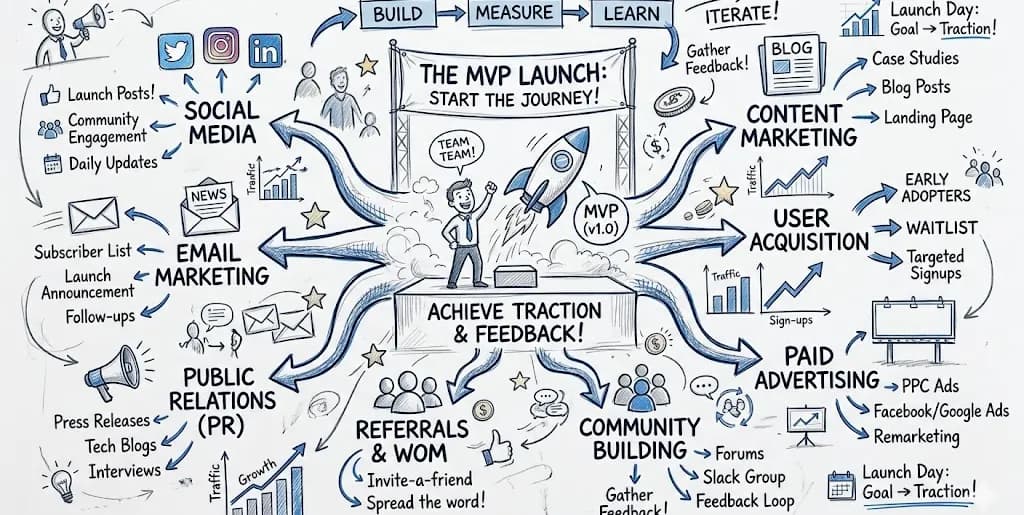
MVP marketing is the set of distribution and positioning activities used to acquire the first 10 to 1,000 users of a product that is deliberately incomplete. The goal is not revenue or reach. It is learning — validating that a specific audience has a problem painful enough to adopt an early, rough solution.
This guide is written for founders and early marketing hires working with a shipped (or nearly shipped) MVP. It focuses on what actually works at this stage, what to skip, and how to recognize when you are ready to graduate from MVP marketing to something bigger.
What MVP Marketing Is (and Isn't)
An MVP, in the original Eric Ries sense, is a product with just enough features to test a hypothesis about customer demand. MVP marketing is the corresponding distribution practice: enough activity to test a hypothesis about go-to-market.
MVP marketing is:
- Narrow — one audience, one problem, one channel
- Founder-led — done by the people who understand the product best
- Qualitative — focused on conversations and learning, not conversion rates
- Cheap — under $5,000/month for most pre-seed and seed-stage startups
- Short-cycle — weekly measurement of what is or isn't working
MVP marketing is not:
- Paid acquisition at scale
- SEO content strategies aimed at 12-month compounding
- Brand-building campaigns
- Hiring a full marketing team
- Automation-heavy workflows
Teams that try to run "real" marketing during MVP stage typically burn 6 months and half their runway building infrastructure before they have evidence anyone wants the product.
Before You Market: Confirm Problem-Solution Fit
Marketing an MVP to cold audiences when you haven't validated the problem is the fastest way to waste money. Before a single ad or blog post, confirm:
- You have talked to at least 20 people in your target audience and they describe the problem in their own words.
- The problem shows up in their top 3 priorities for the quarter — not "yeah, that would be nice to solve."
- At least 3 of them have tried to solve it with a workaround, competitor, or internal build.
- You have shown them your MVP and observed real reactions, not polite nods.
If any of these are missing, go back to discovery. No marketing tactic fixes a problem-solution mismatch.
The First 100 Users: Channels That Actually Work
Distribution at this stage comes from five channels, in rough order of reliability:
1. Direct Outreach (Most Reliable)
Write a personalized message to 100 people in your target audience. Not a mass email — actual research-first messages that demonstrate you understand their specific situation. A 15-25% response rate is realistic when the message is genuinely personalized.
Tools: LinkedIn Sales Navigator, Apollo, Clay for lead data; Lemlist or Smartlead for sending; Google Sheets for tracking.
Best for: B2B, high-ACV products, prosumer tools.
2. Founder Content on Native Platforms
Publishing directly where your audience already hangs out. For developer tools: HackerNews, dev.to, X (formerly Twitter). For SaaS operators: LinkedIn, IndieHackers. For creators: YouTube, Substack.
The pattern that works: publish a specific story, observation, or framework 2-3 times per week for 90 days. Include soft mentions of what you are building. A single founder post that hits can generate more qualified signups than three months of paid ads.
3. Communities
Active participation in 2-3 communities where your audience already lives. Slack groups, Discord servers, subreddits, Circle communities, niche forums. The rule: contribute value for 4-8 weeks before mentioning your product. Most community-led acquisition fails because founders pitch on day one.
4. Adjacent Creator Partnerships
A 30-minute podcast appearance on a show with 3,000 listeners who match your ICP outperforms a billboard in Times Square for an MVP. Offer to share data, run a joint experiment, or give the host's audience something unique.
5. Product Hunt and Similar Launch Platforms
One-shot launch tactics. Good for getting a week of attention and a spike of signups. Bad as a sustained growth channel. Plan for Product Hunt only after you have 50-100 beta users and a polished landing page. Launching too early produces a spike with no follow-through.
What to Skip at MVP Stage
- Paid ads beyond small experimentation budgets. If you can't acquire users organically, paid acquisition will not save you — it will just make your bad economics expensive.
- SEO as a primary channel. SEO compounds over 12-18 months. At MVP stage you need signals in weeks. Publish content for positioning and founder brand, not for organic ranking.
- Brand guidelines and design systems. Pick a defensible name and one color palette. Everything else is premature.
- Marketing automation platforms. Use Mailchimp, Loops, or Resend for simple email. You do not need HubSpot at 200 users.
- PR agencies. Below $1M ARR, PR agencies produce more noise than signal. If you need PR, pitch journalists directly with a genuine story.
- "Growth hacks." Referral programs, viral loops, and waitlist gamification work after you have product-market fit, not before. At MVP stage they feel productive but rarely convert cold traffic.
Positioning: The Work That Matters Most
At MVP stage, positioning work has higher ROI than distribution work. The tightness of your audience definition and value claim determines whether any channel will work.
Bad MVP positioning: "A platform for small businesses to improve their online presence."
Good MVP positioning: "A weekly SEO audit for e-commerce founders running Shopify stores with under 50 products who can't justify hiring an SEO agency."
The good version fits on a business card, excludes 99% of the world, and lets you write a message that resonates with the 1% that matters. See competitor analysis for how to identify positioning gaps your MVP can uniquely fill.
Test positioning by reading it aloud to 5 target customers. Ask them to paraphrase what the product does. If they can't, the positioning isn't tight enough.
Measuring What Matters at MVP Stage
Traditional marketing metrics (CAC, LTV, conversion rate) assume baselines that MVP stage does not have. Measure differently:
| Metric | Why It Matters at MVP | Rough Target |
|---|---|---|
| Qualified conversations per week | Proxy for problem-fit validation | 5-10 during active outreach |
| Signup-to-activation rate | Shows whether MVP delivers on its promise | 40-60% for a successful MVP |
| Week-1 retention of activated users | Earliest meaningful engagement signal | 30-50% |
| Net Promoter Score from early users | Qualitative signal of love vs. indifference | >30 net promoter early signal |
| User requests for specific features | Indicates which direction to build next | High volume = strong engagement |
| Organic mentions per week | Whether your users talk about you unprompted | Any is a good sign |
Do not track vanity metrics (Twitter followers, page views, impressions) in the MVP phase. They consume attention without producing decisions.
The 10x10x10 Founder Routine
A simple rhythm that works at MVP stage: every week, do 10 direct outreaches, 10 community contributions, and 10 minutes of customer conversation. Maintain this for 12 weeks.
At the end of 12 weeks (about 360 touchpoints), you will have generated enough signal to know whether your positioning resonates, which channel works best, and what feature gaps are blocking adoption. This is the pattern that got most successful SaaS companies their first 100 paying customers — not clever tactics, but consistent founder-led effort against a narrow audience.
When to Graduate From MVP Marketing
You are ready to move beyond MVP marketing when three conditions hold:
- You can articulate exactly who your customer is in one sentence, and show evidence that they convert at meaningfully higher rates than other audiences you have tested.
- You have a repeatable acquisition channel — a specific activity that consistently produces qualified leads, not just occasional wins.
- Retention is good enough to support the growth math — typically >80% monthly for B2B SaaS, >60% for prosumer tools, >40% for consumer apps.
Before these conditions are met, scaling marketing usually produces diminishing returns. After they are met, hiring a marketing lead, testing paid acquisition, and investing in long-cycle channels like SEO and topical authority become reasonable bets.
Common MVP Marketing Traps
- Hiring a marketing agency too early. Agencies need clear briefs. At MVP stage you don't have them yet, so you pay for mediocre execution of unclear strategy.
- Building before validating. Spending 6 weeks on a polished website before any user validation is wasted effort. Use a one-page site and an email collection form for the first 50 conversations.
- Hiding from users. Founders who avoid customer conversations because they are "too busy building" are the ones who ship products nobody wants.
- Copying the playbook of a company 5 stages ahead. What works at Stripe's scale does not work for a 3-person team with $200k in the bank. Learn from stage-appropriate case studies.
- Confusing activity with progress. Publishing 3 blog posts, setting up a newsletter, and launching social accounts feels productive. It rarely produces qualified users in the MVP phase.
MVP Marketing Toolkit
A minimum-viable toolkit for MVP-stage marketing:
- Landing page: Framer, Webflow, or a simple Next.js template
- Analytics: Plausible or simple GA4
- Email: Loops, Resend, or Mailchimp
- Outreach: Apollo + Smartlead, or manual via LinkedIn Sales Navigator
- Customer conversations: Granola or similar AI notetaker, a simple Airtable or Notion base for CRM
- Content distribution: direct posting on 1-2 platforms, Buffer for scheduling only if essential
Total monthly cost: $100-500. Anything above $500/month in tooling at MVP stage is usually premature.
Frequently Asked Questions (FAQ)
Q1: How long should the MVP marketing phase last?
Typically 3-9 months. If you can't find product-market fit signals in that window, the problem is usually with positioning or product-problem fit, not marketing. Extending MVP marketing beyond 12 months without meaningful traction is a signal to pivot, not to try harder.
Q2: Should I spend on Google or Facebook ads during MVP?
Small experimental budgets (under $500/month) can help validate messaging hypotheses — but only after organic traction exists. Paid acquisition with no organic baseline tells you whether your payment method works, not whether your product works.
Q3: When should I hire my first marketer?
After you have clear signs of repeatable acquisition from at least one channel and are ready to scale it. Hiring before this produces a marketer who has no strategy to execute, leading to frustration and turnover.
Q4: Is content marketing worth it for an MVP?
Only if used for positioning and founder brand-building, not as a traffic acquisition strategy. A weekly post on LinkedIn or Substack that reaches 1,000 target readers generates more qualified leads than a blog buried on page 5 of Google.
References
- Steve Blank: The Customer Development Manifesto
- Paul Graham: Do Things That Don't Scale
- First Round Review: Getting to Product-Market Fit
- Y Combinator: Startup School