
Bad SEO Practices to Avoid
Learn which bad SEO practices still hurt rankings, from keyword stuffing and link schemes to ignoring user intent and user experience.
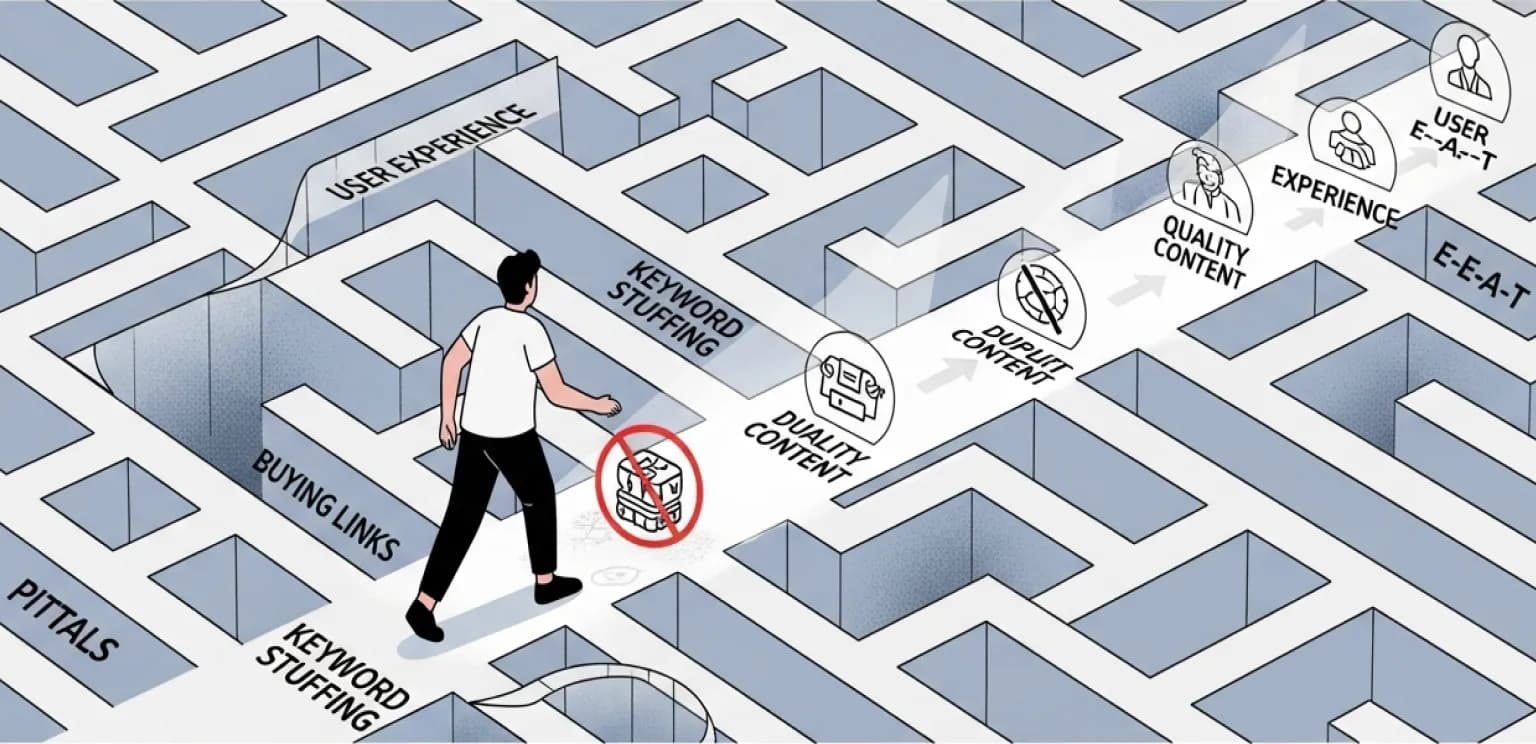
Bad SEO practices are usually not mysterious. They are the same avoidable patterns that keep showing up in audits: keyword stuffing, thin intent matching, manipulative links, duplicate pages, and sites that are harder to use than they need to be.
The problem is not just that these tactics are outdated. They can waste crawl budget, erode trust, trigger spam signals, and keep a site stuck even when the team is publishing consistently.
This guide breaks down the most common bad SEO practices, why they still cause damage, and what to do instead if you want durable search visibility rather than short-lived tricks.
Why You Need to Ditch These Bad SEO Practices Now
Ignoring modern SEO principles isn't just about missing out on traffic; it's about actively damaging your site's potential. Google's algorithms are constantly evolving, becoming more sophisticated and user-centric. What worked a decade ago, or even a few years ago, can now trigger penalties or simply render your efforts useless. These bad SEO practices aren't just ineffective; they're dangerous. They signal to search engines that your site might not be trustworthy or valuable, leading to lower rankings, reduced organic traffic, and a significant hit to your brand's credibility.
It’s time to stop guessing and start building. Let's dive into the practices you absolutely must avoid and the smart, sustainable strategies that will propel you forward.
The 8 Bad SEO Practices to Avoid (And What to Do Instead)
1. Keyword Stuffing: The Old-School Blunder
You remember the old days, right? When people thought repeating their target keyword a hundred times would magically make them rank. It was like shouting the same word over and over at our smart librarian, hoping she'd notice.
The Bad Practice
Keyword stuffing is exactly what it sounds like: cramming an excessive number of keywords into your content, often in an unnatural or repetitive way. This includes hiding keywords in tiny text, using them in irrelevant contexts, or simply overusing them in your body copy, meta descriptions, and alt text. It makes your content unreadable for humans and signals to search engines that you're trying to manipulate rankings. Google's algorithms are far too smart for this now. They see it as a desperate, low-value tactic, and they will penalize you for it. I've seen sites get hammered by Google for aggressive keyword stuffing, losing 90% of their organic traffic overnight. It's a brutal lesson to learn.
What to Do Instead
Focus on topical authority and natural language. Instead of just one keyword, think about the topic you're covering. What related terms, questions, and sub-topics would a user expect to find? Use a variety of relevant keywords and phrases that naturally flow within your content. Write for your readers first, not for search engines.
- Semantic SEO: Understand the broader meaning and context of your topic.
- User Intent: What is the user really trying to find or do? Address that comprehensively.
- Related Terms: Incorporate synonyms, long-tail variations, and related concepts naturally.
- Readability: Ensure your content is a joy to read, not a keyword minefield.
When you write naturally and comprehensively about a topic, Google understands your content's relevance far better than if you just repeat a single phrase.
2. Neglecting User Experience: It's Not Just About Keywords
Imagine walking into a coffee shop. If the line is endless, the service is slow, and the menu is confusing, you're probably going to leave and find another place, right? Your website is no different.
The Bad Practice
Many sites still prioritize technical SEO or content creation while completely overlooking the actual experience of their users. This includes slow loading times, non-mobile-friendly designs, confusing navigation, intrusive pop-ups, and poor content readability. These issues frustrate visitors, leading to high bounce rates and short session durations. Google pays close attention to these user signals because they indicate whether your site is actually helpful and enjoyable. If users consistently have a bad time, Google will eventually stop sending them your way. We once worked with a client whose site took 8 seconds to load on mobile. Just fixing that one issue led to a 20% drop in bounce rate and a noticeable bump in rankings.
What to Do Instead
Prioritize Core Web Vitals and a seamless user journey. Google explicitly uses Core Web Vitals (Largest Contentful Paint, First Input Delay, Cumulative Layout Shift) as ranking factors. These metrics directly measure loading performance, interactivity, and visual stability. A fantastic user experience keeps visitors engaged, reduces bounce rates, and encourages them to explore more of your site.
- Optimize Page Speed: Compress images, leverage browser caching, minimize CSS/JavaScript. Use tools like Google PageSpeed Insights to diagnose issues.
- Mobile-First Design: Ensure your site is fully responsive and looks great on all devices. Google primarily uses the mobile version of your content for indexing and ranking.
- Clear Navigation: Make it easy for users to find what they're looking for with intuitive menus and internal linking.
- Readability: Use clear headings, short paragraphs, bullet points, and appropriate font sizes.
- Minimize Intrusions: Be mindful of pop-ups and ads. They should enhance, not detract from, the user experience.
A happy user is a signal to Google that your site is valuable.
3. Buying Links or Participating in Link Schemes: A Risky Shortcut
Think of links as votes of confidence. If someone genuinely links to your site, they're saying, "Hey, this content is great!" But what if you just buy those votes?
The Bad Practice
Buying links, participating in link farms, excessive reciprocal linking, or any other manipulative tactic designed to artificially inflate your backlink profile is a massive red flag for Google. These are considered "black hat" SEO techniques. While they might offer a temporary boost, they almost always lead to severe penalties, including manual actions that can completely de-index your site. Google's algorithms are incredibly sophisticated at detecting unnatural link patterns. It's a shortcut that leads directly to a dead end, and often, a very public fall from grace.
What to Do Instead
Earn high-quality, natural backlinks. Focus on creating genuinely valuable, shareable content that people want to link to. Think of it as building real relationships and providing real value, not just collecting numbers.
- Create Exceptional Content: Produce in-depth guides, original research, compelling infographics, or engaging videos that naturally attract attention and links.
- Strategic Outreach: Identify relevant websites and influencers in your niche and genuinely connect with them. Share your valuable content and suggest how it might benefit their audience.
- Broken Link Building: Find broken links on reputable sites and suggest your relevant content as a replacement.
- Guest Posting (Ethically): Contribute high-quality, original content to other authoritative sites in your industry, earning a natural link back to your site in your author bio or within the content itself (if relevant).
- Brand Mentions: Focus on building your brand's reputation so that people naturally talk about and link to you.
Earning links takes time and effort, but the results are sustainable, penalty-free, and build genuine authority.
4. Ignoring Search Intent: Talking to the Wrong Audience
You wouldn't try to sell a coffee machine to someone looking for a cup of coffee, right? They have different needs. The same applies to search intent.
The Bad Practice
Many content creators make the mistake of producing content based solely on a keyword's search volume, without considering why someone is searching for that term. For example, if someone searches "best coffee," are they looking for a list of coffee bean brands to buy (commercial intent), or are they looking for a guide on how to brew the perfect cup at home (informational intent)? If your content doesn't match the user's underlying intent, they'll quickly bounce, signaling to Google that your page isn't helpful. This is a massive missed opportunity and a waste of your content creation efforts.
What to Do Instead
Deeply understand and address user search intent. Before you write a single word, research what users really want when they type a specific query into Google. Look at the top-ranking results for your target keyword. What kind of content are they? Are they blog posts, product pages, "how-to" guides, or comparison articles? This is your blueprint.
- Informational Intent: Users want to learn something (e.g., "how to make cold brew"). Provide comprehensive guides, tutorials, or explanations.
- Navigational Intent: Users are looking for a specific website or page (e.g., "Starbucks near me"). Ensure your site structure is clear and your brand name is prominent.
- Commercial Investigation Intent: Users are researching before making a purchase (e.g., "best espresso machine reviews"). Offer comparisons, reviews, and detailed product information.
- Transactional Intent: Users are ready to buy (e.g., "buy espresso machine online"). Provide clear product pages, pricing, and a smooth checkout process.
Tailoring your content to match search intent is a fundamental principle of modern SEO. It ensures you're serving the right content to the right person at the right time.
5. Duplicate Content: Confusing Search Engines (and Users)
Imagine our librarian has two identical copies of the same book, but they're in different sections of the library. She wouldn't know which one to recommend, would she?
The Bad Practice
Duplicate content refers to identical or near-identical content that appears on more than one URL on your own site or across different domains. Common culprits include printer-friendly versions of pages, e-commerce sites with product variations (e.g., same product, different color URL), or syndicated content without proper attribution. When Google finds multiple versions of the same content, it doesn't know which one to rank. This dilutes your ranking potential, as Google has to choose a "canonical" version, and it might not be the one you prefer. In some cases, it can even be seen as a manipulative tactic, though typically it's more of a technical oversight.
What to Do Instead
Consolidate, redirect, or use canonical tags. Your goal is to ensure that Google always knows which version of a piece of content is the "master" version you want indexed and ranked. This clarifies your site's structure and prevents your ranking signals from being split across multiple URLs.
- Canonical Tags: Use the
<link rel="canonical" href="[preferred-URL]"/>tag in the<head>section of duplicate pages, pointing to your preferred version. This tells Google, "This page is a copy; please consider the original at this other URL." - 301 Redirects: If you have multiple old pages with very similar content that you want to consolidate into one, use a 301 (permanent) redirect to send users and search engine bots from the old URLs to the new, preferred one.
- Parameter Handling: For e-commerce sites with URL parameters (e.g.,
?color=red), configure your Google Search Console settings to tell Google how to handle these parameters. - Unique Content: The best solution is always to create unique, valuable content for every page. If you have similar topics, find a unique angle or expand on them sufficiently to justify separate pages.
Regular content audits can help you identify and fix duplicate content issues before they cause problems.
6. Over-Optimizing Anchor Text: A Red Flag
Anchor text is the clickable text in a hyperlink. If every single link to your site says "best coffee beans," it looks suspicious, right?
The Bad Practice
Over-optimizing anchor text means consistently using the exact same keyword-rich phrase for all or most of your internal and external links pointing to a specific page. For instance, if you're trying to rank for "organic coffee beans," and every single link to that page uses "organic coffee beans" as its anchor text, it looks unnatural. Google interprets this as an attempt to manipulate rankings, much like keyword stuffing. It's a clear signal that you're trying to artificially boost a specific keyword, and it can lead to penalties or simply a devaluation of those links. My own tests consistently show that a diverse anchor text profile performs far better and appears more natural.
What to Do Instead
Diversify your anchor text naturally. Think about how real people link to content. They use a variety of phrases, not just one specific keyword. Your anchor text profile should look organic and varied, reflecting the many ways people might refer to your content.
- Branded Anchor Text: Use your brand name (e.g., "Our Coffee Co.").
- Naked URL: Simply use the URL itself (e.g.,
www.yourcoffeesite.com). - Generic Anchor Text: Use phrases like "click here," "read more," "this article."
- Partial Match: Include your keyword along with other words (e.g., "learn more about our organic coffee beans").
- Exact Match (Sparingly): Use your exact target keyword, but only a small percentage of the time, and only when it feels completely natural.
- Long-Tail Anchor Text: Use longer, descriptive phrases that provide context (e.g., "our comprehensive guide to sourcing organic coffee beans").
The key is to make your linking strategy look natural and helpful to the user, not manipulative to the search engine.
7. Forgetting About Local SEO: Missing Nearby Customers
If your coffee shop is amazing, but no one searching "coffee shop near me" can find you, you're losing business every single day.
The Bad Practice
Many businesses, especially small and medium-sized ones, overlook the critical importance of local SEO. They might have a great website but fail to optimize for local searches, ignoring their Google Business Profile, local citations, and geo-targeted keywords. This means they're invisible to potential customers who are physically nearby and actively searching for their products or services. In a world where "near me" searches are booming, this is a massive oversight that directly impacts foot traffic and local sales.
What to Do Instead
Optimize your presence for local searchers. Local SEO is about ensuring your business appears prominently in search results for users in your geographic area. This is especially crucial for brick-and-mortar businesses or service providers operating in specific regions.
- Google Business Profile (GBP) Optimization: This is your #1 tool for local SEO.
- Claim and verify your listing.
- Complete every section: accurate name, address, phone number (NAP), hours, website, categories, services, photos.
- Encourage and respond to customer reviews.
- Post updates and offers regularly.
- NAP Consistency: Ensure your Name, Address, and Phone number are identical across all online directories (Yelp, Facebook, industry-specific sites, etc.). Inconsistencies confuse search engines.
- Local Keywords: Integrate location-specific keywords into your website content (e.g., "best coffee shop in [Your City]," "espresso machine repair [Your Neighborhood]").
- Local Citations: Get listed in relevant online directories and local business listings.
- Local Landing Pages: If you serve multiple locations, create dedicated, optimized landing pages for each.
Local SEO is a direct pathway to customers who are ready to buy or visit. Don't leave money on the table.
8. Chasing Algorithm Updates Instead of User Value: The Endless Race
Imagine trying to hit a moving target that changes direction every week. That's what it feels like to chase Google's algorithm updates.
The Bad Practice
A common, exhausting, and ultimately ineffective practice is to constantly tweak your website and content in response to every rumored or confirmed Google algorithm update. This often leads to reactive, short-sighted changes that prioritize "tricking" the algorithm over providing genuine value to users. You might see sites frantically adding or removing keywords, changing content length, or altering site structure based on speculation. This approach is a never-ending, stressful race that distracts from the core mission: creating an excellent user experience. It often results in content that feels disjointed, unauthentic, and ultimately, less helpful.
What to Do Instead
Focus on E-E-A-T and user-first content. Google's overarching goal with every algorithm update is to deliver the most helpful, reliable, and high-quality results to its users. By consistently focusing on providing exceptional value, you align perfectly with Google's objectives, making your site naturally resilient to updates. E-E-A-T stands for Experience, Expertise, Authoritativeness, and Trustworthiness.
- Experience: Demonstrate first-hand experience with the topic. Have you actually used the product or service you're reviewing? Share your personal insights.
- Expertise: Showcase your knowledge. Are you a recognized expert in your field? Provide credentials, qualifications, or deep insights.
- Authoritativeness: Build your reputation. Are other experts and authoritative sites referencing your work? Is your brand known as a go-to source?
- Trustworthiness: Be transparent and accurate. Is your information verifiable? Do you have clear contact details, privacy policies, and security measures?
When you consistently create content that exhibits strong E-E-A-T, you're building a truly valuable resource that Google will want to rank, regardless of minor algorithm tweaks. Write for people, not just search engines, and you'll always be ahead of the curve.
Your SEO Comeback Starts Now
The fastest path out of bad SEO is usually subtraction. Remove the manipulative tactics, fix the thin or duplicative pages, and make the site easier to crawl and easier to use.
Once the foundation is clean, your content has a much better chance of earning visibility on merit instead of fighting against technical debt and weak signals.
Quick takeaways
- Most bad SEO comes from chasing shortcuts instead of solving user intent.
- Low-quality links, thin content, and duplicate pages create long-term cleanup work.
- Technical quality and usability matter as much as on-page copy.
- The safer strategy is helpful content, clear structure, and evidence that the page deserves to rank.
References
- Google Search Central: Search Essentials
- Google Search Central: Creating helpful, reliable, people-first content
- Google Search Central: Spam policies for Google web search